

The current crisis in mathematics is unparalleled. Not that there had not been challenges before: the Pythagoreans had to grapple with the existence of irrational numbers. The Galois drama illustrates the crisis, when the realization dawned that explicit solution formulas to polynomial equations do not exist for degree 5 or higher polynomials. Non-Euclidean geometry uprooted traditional geometric intuition. Turing allowed to see that there are fundamental computational problems which are not computable by machines. Work of Cook and others showed that there are fundamental complexities in mathematical tasks. The Grundlagenkrise one hundred years ago culminated in the realization of incompleteness: there is no ultimate axiom system in mathematics and worse, there is no proof within the system that the system is consistent. The current crisis is a more serious challenge: mathematical knowledge might soon be produced with little human input or oversight. We need to re-evaluate motivation. There are painful deformation in value functions. [* In the Gazette of today one can read that we are in a Copernican moment”. What is our place when we are no longer at the center of things?”] I focus here on math, where a major battle in a war against the machines just has been lost and dozens of battle fields are littered with corpses of dead conjectures, killed by the machines.
In education, we see the most serious battles right now. There had been education wars before. Each of them had strong impacts in education. Technology played a pivotal role in each one. Almost nobody can compute square roots on paper and pencil any more. Very few even can divide two numbers on paper. College students grapple with elementary math. Computer algebra killed the ability to find integrals by hand. The Moocs war was about replacing in person reduction with online education, feed canned fast food content recorded years ago by some random dude and test students or have them be peer evaluated by each other. It had a serious impact and has had the effect that large junks of education which have been done by universities has shifted to technology companies, in only 2 decades. The pandemic has accelerated this: during the 2 years I used tools from 18 companies (slide from a presentation from 2023, where I also used some AI illustrations but labeled them as such), things we have all done ourselves. At the moment, we have to fight AI slop, which includes research work that has been written by AI. It is a challenge as it up-bends the evaluation system. Evaluating humans is still important in an economy, where people seek employment. Having solved a major problem is suddenly no more a big achievement. The question “how it has been done” has become more important. The process of automatic fast food kitsch threatens the entire education system. I’m aware that some might also gloat about this as the intellectual elite in universities has become arrogant. We live (I include myself) in an “ivory tower” detached from realities and challenges. It now feels like the assault onto Minas Tirith in the “return of the king”. There might be no Rohirrim or Army of the dead who help save the day.
| War | Human Generation | Triggered by | Technology | Reduced importance of |
| New Math | X | Cold war | Calculators, TV | Numerical Skills |
| Math Wars | Y | Computer algebra | PC’s, Internet | Algebraic Skills |
| Moocs wars | Z | Social Media | Apps, Algorithms | Interpersonal Skills |
| AI wars | alpha | AI Slop | LLM’s | Writing Skills |
A) How do we keep the motivation to learn, to teach, to know? One answer is that creativity grows best within a brain that contains information. Even the machines know that. They have read almost every textbook ever published. Knowing things also allows to connect dots. The philosopher Arthur Brooks identified joy, achievement and purpose as major nutrients for happiness. Copy paste the answer of problem set into a paper or letting a machine generate a paper is neither joy, nor any achievement. It has no long term purpose. It is like winning the tour de France with a motor built into the bike or by using doping. As in sports, we will need tools to identify fraud.
B) We need to readjust values. Entering an open problem into a machine search engine and getting a Lean verified proof is of little value any more. What matters, at least for a while still, are ideas, communication and the ability to do things in person. There are gigantic differences between “pioneering”, “building” and “using”. Advances from AI have shifted the values. The machines are no more just use to “use” but to “actively build”. We will have to do more pioneering (until that part is also taken away). The current developments have de-evaluated building to using. We see this moronic advertisements on the web, where some random person tells “I just built an app to do so and so”, and where an experienced engineer answers “no way!” and the boss rewards the moron who vibe coded the app.
| Pioneer | Build | Use |
| Invent an Airplane | Fly an Airplane | Be a passenger |
| Discover a climbing route | Send it red point | Watch it on youtube |
| Invent a computer architecture | Build a computer | Use a computer |
| Build a programming language | Write programs | Use programs |
| Write a course | Teach a course | Hand out books |
| Build a theory | Prove a theorem | Read a polished proof |
C) What we do not want in math education. Education faces the biggest challenge. It is hard to say what to do. It is easier to say where we do not want to go: we definitely do not want to reach a situation, where
Teachers write problems with AI, students solve the problems with AI and teachers grade the problems using AI.
Unfortunately, we are in many cases already in such a scenario and modern technology try to moves us there. It is a very, very attractive Nash equilibrium. Those who resist lose. But the consequence of course is to cut the middle men and just do it right within the machine. Why move information to humans at first?
D) What we do not want in research. But also in research, we still in denial, what is going on. Again it is easier to see what we do not want: we do not want to head into a situation, where
Authors write AI papers, referees evaluate them with AI and bots learn from this AI generated slop.
As Yuval Harari recently pointed out: it is the first time in history that we can not predict even 10 years ahead. A horror scenario for human intelligence is to have machines generate mathematical theories that humans can no more understand. They do not need us to understand: Lean verified proofs have started to flood the market. The Navier Stokes proof of the existence of driven blow-up solutions is partly Lean verified. Even the Millenium problems have become Kitsch. There used to be artists who with bare hands and a knife or hammer and chisel could mold a sculpture from wood or stone. The 3D printed kitsch analog is almost free. And there are already bots who are able to sculpture (using real hammer and chisel) from real marble stone which makes the product not look different than human generated.
E) We might have to use different values as criteria. In a time, where some authors write 300 novels a year, the publication count is definitely no more a standard. Also book prizes have become a joke now, once we have awarded prizes for AI generated slop. Changes in technology is not unprecedented: I myself made my first steps in writing mathematics with an IBM typewriter where typing a symbol would mean having to physically change the “typeball” and to use erase tape to fix a wrong letter (or start all over). Still at the time of graduate school, universities had secretaries who would type papers and books. Since it has become so easy to write decent papers with a push of a button, the standard of what a paper is, might have to be lifted. Writing has become cheap. A paper needs not only to prove a theorem or solve an old problem but seriously push the envelope on what has been done before.
F) Maybe we need to separate some tasks completely from AI. The problem is that it can be contaminated by AI. It is like having 100 meter sprints with people. Bots now run faster than Usain Bolt. The fight against doping and technological cheating in sports has been raging a long time already. Now this all comes to academics. A researcher might have to be able to explain without tools the results. This could be automatized. In education, we might have to go back to oral exams. But this also needs teachers that still know their stuff. We do not want to delegate the oral exams to the machines. Maybe there should be a codex that teaching should not be done by machines, that evaluation or refereeing should not be done by machines, that promotion decisions should not be made by machines.
G) What do I do personally right now?
- I try to stay autonomous. Keep my knowledge base local. Keep my library of books, programs, media. Live as if tomorrow no artificial intelligence would exist. As for now, I would not mind if all this technology would go down the drain. I still would be able to do math just fine, even if computers would disappear. There is the real danger to become dependent on systems which eventually need to produce profit.
- I try to keep parts of my work away from the bots. This means to be extreme. No proof reading, no spell checking. This means even not asking a search engine (they are contaminated by AI already). This slows me down, makes my text have errors, but it keeps me excited about a problem and keeps me human. I actually think that it is quite effective to struggle with a problem (at least for a few months or even years) without even asking a search engine about it. They are already infested by (still very bad) AI.
- AI does not get access to my computers. Such technology (copilot on windows or apple intelligence ) I do neither need, nor want to have). I keep control on what runs on my machine. I do not need random on a platform I do my thinking. If I want to chose random, I can, like reading a book, watching a movie or talking to somebody. If I work, I need to be able to reproduce a result or thought.
- I devalue work that uses AI (even if suspected). This is my personal choice. I down-vote or dislike AI generated slop on the internet even if it is marked as such. If it is not marked as AI but uses AI, it should be considered fake. Even if it is minor use, like channels that generate pictures automatically or have it narrated by an AI voice. I might be a Don Quixote, but AI slop does not need to be rewarded,especially if it does pretend to be human. Some AI generated stuff is great but it needs to be marked as such.
- I keep start to think at a problem with a blank slate. Empty paper and pen. No technology, pure thought. No consultation with books or internet or other people or AI help. This is the ultimate free climb. This is happyness. It is of course also more risky and you get much less far. Especially if the AI use is starting to be expected.
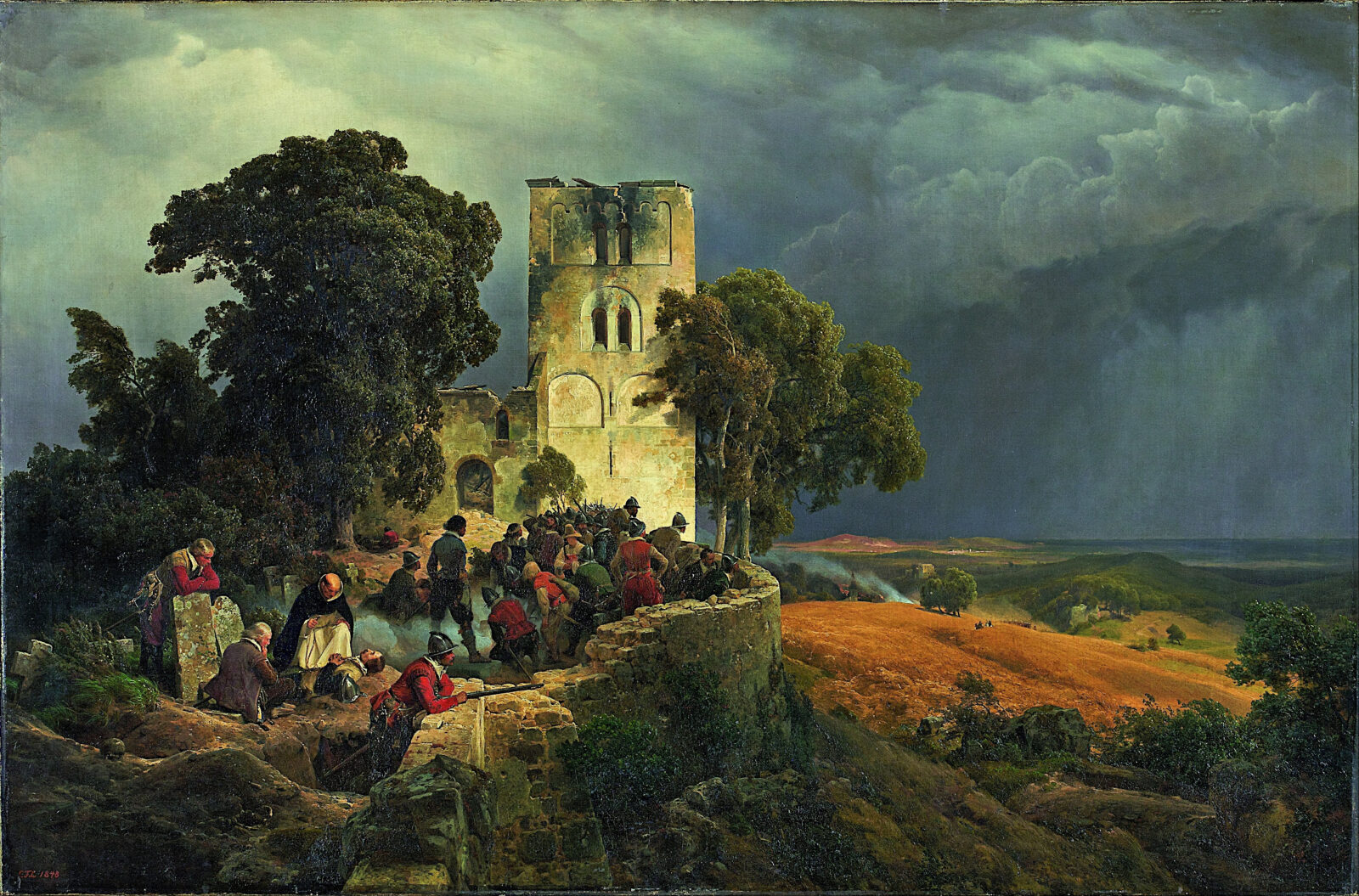


The picture shows a painting from the german Carl Friedrich Lessing (1808-1880) from 1848. Its focus on human endurance rather than flashy heroics. It is a symbol and metaphor for culture threatened by chaos.

