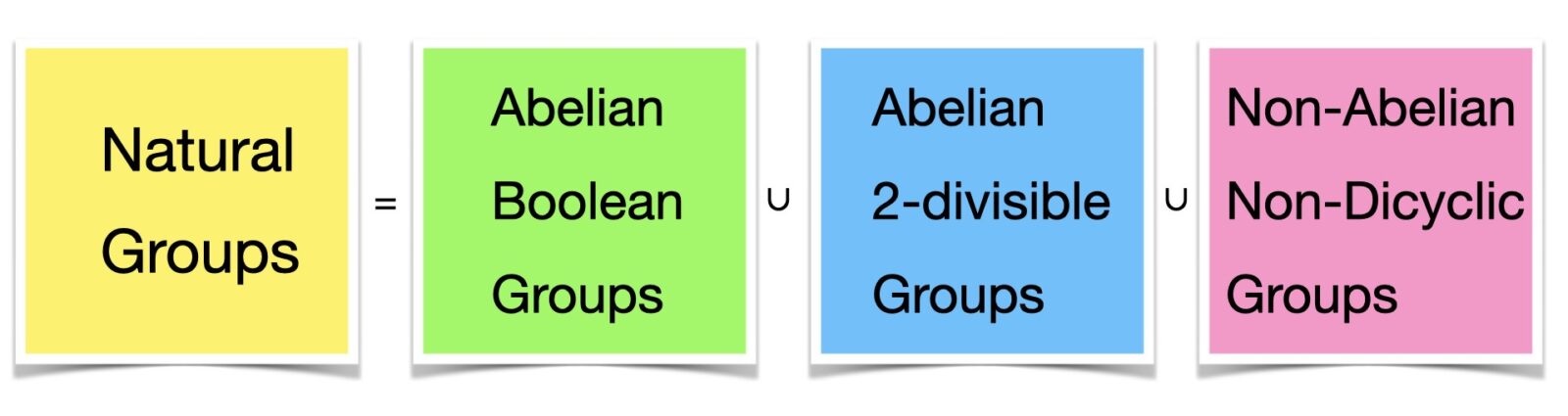
The structure theorem is now fully proven thanks to Alex Sutherland. See his paper submitted on September 27, 2026. The structure theorem had been known before only for groups with cardinality less or equal than . See my paper from September 7, 2026. The structure theorem is given in the following picture. Alternatatively we could characterized non-natural groups now as groups with dihedral competition: either abelian A for which 2A is strictly between 0 and A. Or non-abelian dicyclic G=Dic(A,y). I left always the “genearalixed” away more recently as there is no ambiguity. Dic(A,y) is easy enough to understand as a sibling to Dih(A). In both case one doubles the abelian group and adjoins a new “imaginary element” x. In the dicyclic case x is the square root of an involution y in A. In the dihedral case, x is the square root of -1 in A. In both cases, the new element x conjugates any element in a to its inverse: for all a in A. The two constructions are similar but have fundamentally different properties: Dih(A) is always generated by involutions, while Dic(A,y) is never generated by involutions as all involutions must be in A. The prototype examples are and , the quaternion group. As we have seen last week, dihedral groups are always natural as they are reflection groups so that by the earlier theorem of Sutherland from September 4th, the group is natural. But dicyclic groups are never natural because every right invariant metric d on Dic(A,y) also admits the dihedral competitor Dih(A), and the two groups are not isomorphic as the first is not generated by involutions while the second is.
I’m pretty sure that I would hardly have come up with the ideas needed to prove the full theorem. Maybe just for the record, some of the things I have tried since September 7: as the end of my sepetember 6 paper indicate, I tried during a few 2 hour runs to find a proof of the statement that 2-divisibility 2A=A for Abelian groups implies naturality. I did not get any where. As a dynamical systems trained person, I tried to understand the dynamical system on the Abelian group. The condition 2A=A means that this map T is surjetive. It does not have to be injective however. It does on finite groups but then this just means that the Abelian group has odd order and in that case the naturality condition is clear as there is no dihedral competition. It became clear that one can not just look at the orbits of the map to find an encoding. In the case when the group has cardinality less or equal than the continuum, the situation was already clear before. The automorphism group of A is Dih(A) and 2A=A implies that every reflection in Dih(A) has a non-zero fixed point as can be solved for a. This shows that any regular group action on A must be A. With the cardinality of not exceeding the continuum, one can attach to every color for a length and define if and . This metric on the complete colored Cayley graph of is now a right invariant metric which generates . The problem was that if is larger than the continuum, we can not do produce such a metric. Sutherlands theorem for some right invariant metric d solves the problem but that requires some serious encoding skills.
After Sutherland’s first paper from September 4th I tried something else. (By the way, I got the paper of Sutherland a few days earlier by mail and the same day read it and convinced myself that it works) , I mentioned that preprint my September 7 paper; it prompted me to finish up fast. The world revolves now much faster these days. Weeks are now what years have been before. I tried to prove from A=2A to prove that A is natural using the reflection theorem of Sutherland. The idea was the following cool fact: if 2A=A and Dih(A)=Dih(B) for a second abelian group B, then A is isomorphic to B. For 2-divisible groups, the dihedral group completely encodes the group. Now, use that Dih(A) is a reflection group so that by Sutherland’s reflection theorem, we have a metric d on Dih(A) that is right invariant. This metric induces a metric on A and shows that all Abelian competitors of A must be isomorphic to A. The problem was that we could have a non-Abelian competitor on A which still preseves the metric d by right translation. The Sutherland metric d on Dih(A) restricted to A would not necessarily do the job. It was clear that one would have to refine the encoding used by Sutherland in the reflection group.