
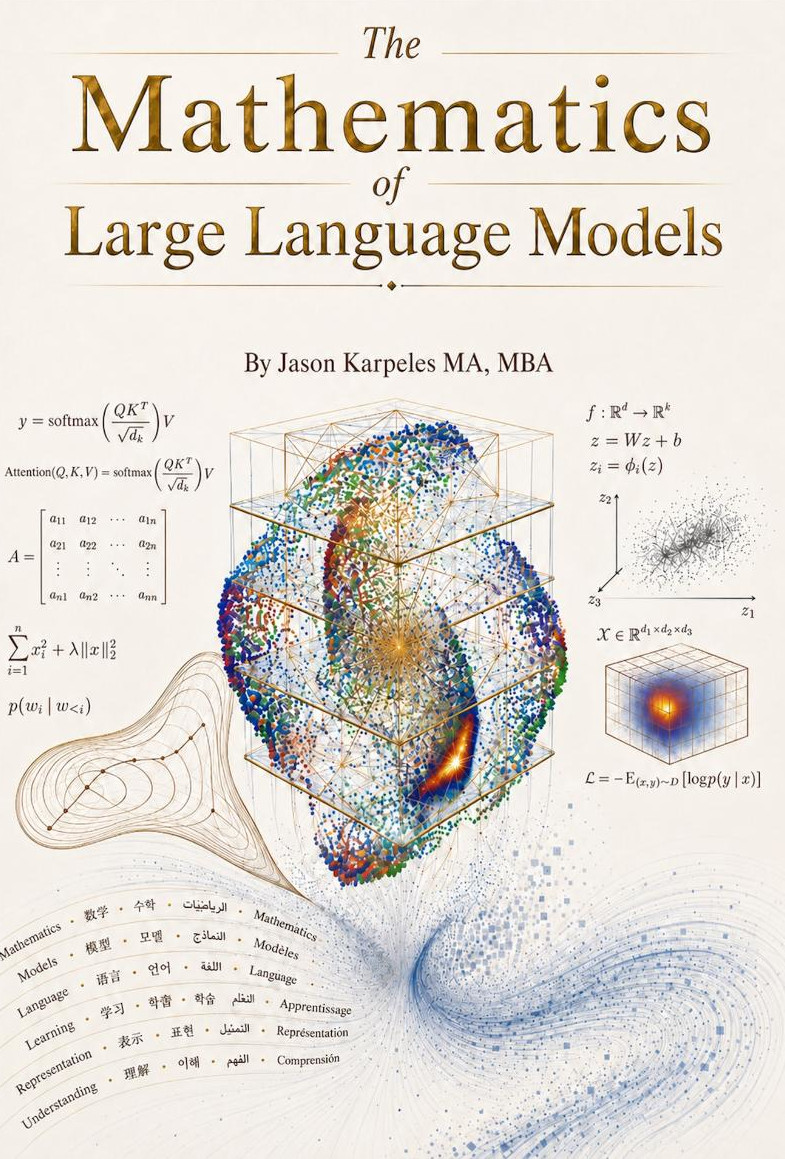


Distinguishing between AI generated mathematics and genuine mathematics will become more and more difficult as time goes on. I recently looked at the book “The Mathematics of Large Language Models” (2026) by Jason Karpeles. My immediate reaction, after reading various sections and scanning the document is that this book is almost entirely AI generated. It is a 2000 page mess, virtually listing just any mathematical topic that could be relevant in AI. For mathematicians, the mathematics of LLMs is actually rather shallow: it builds almost entirely on linear algebra (data fitting and projections in particular), calculus (gradient methods, universal approximation theorem) , probability (rather elementary). See About Math in AI (1 minute clip). But lets look at this 2000 page book. The title looks decent (it is certainly or almost certainly AI generated, this is exactly the style which AI models now use to build illustrations). The book seems to sell well also.
A comparison work:
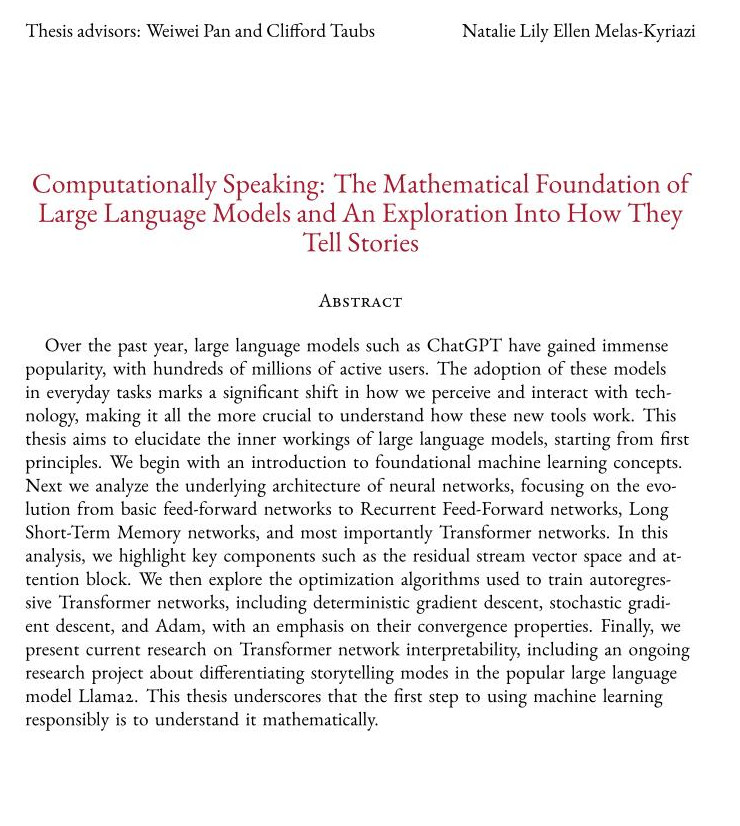
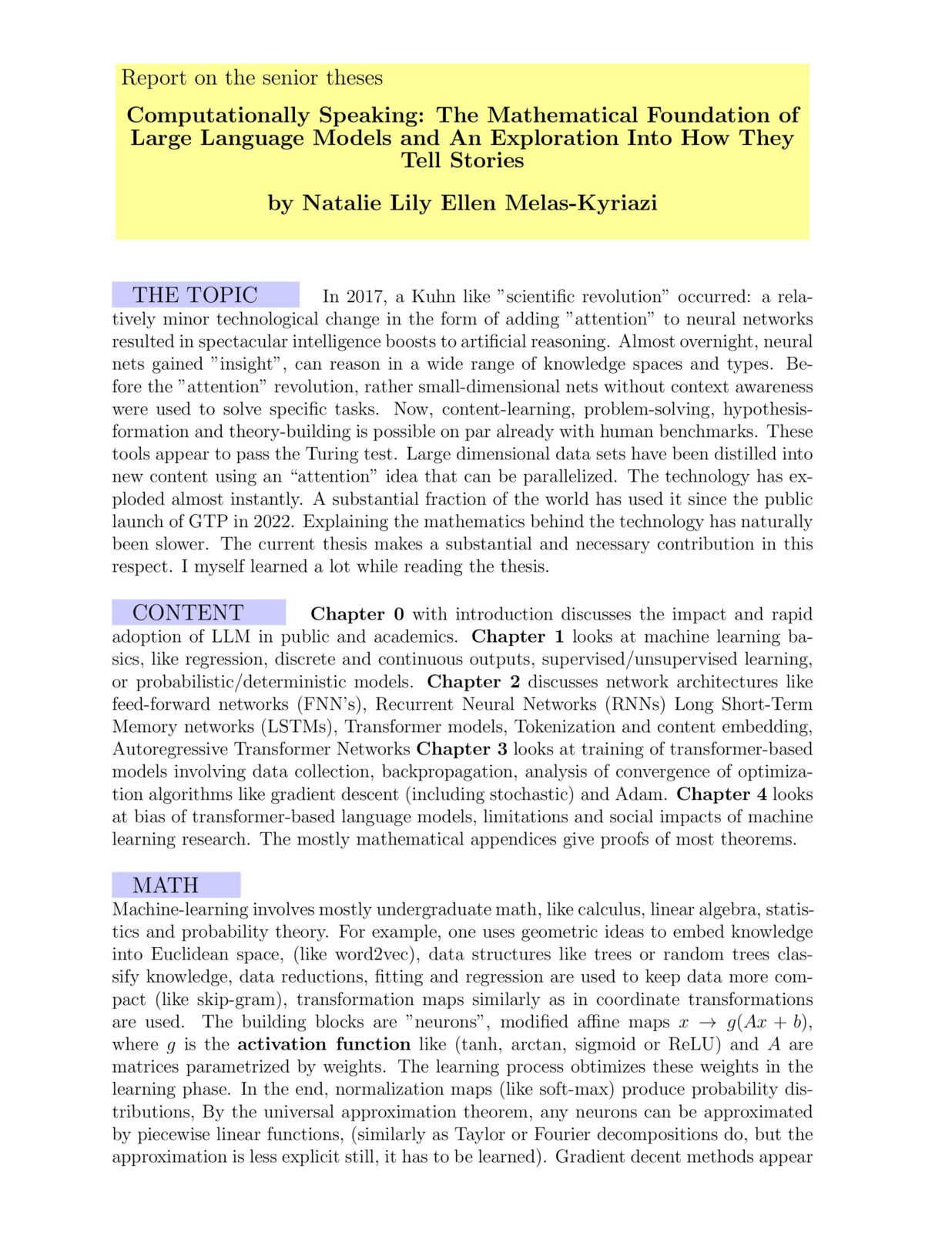
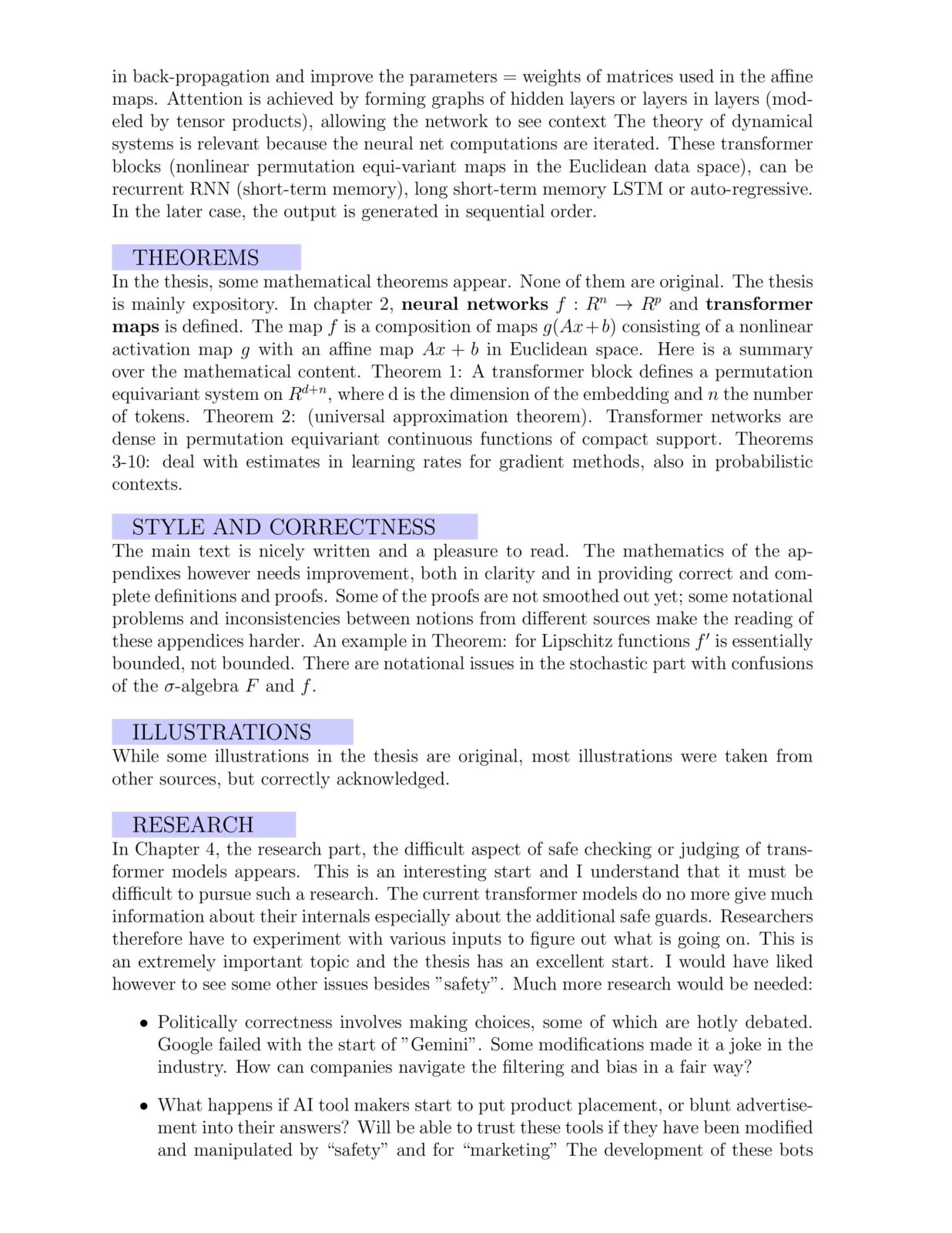
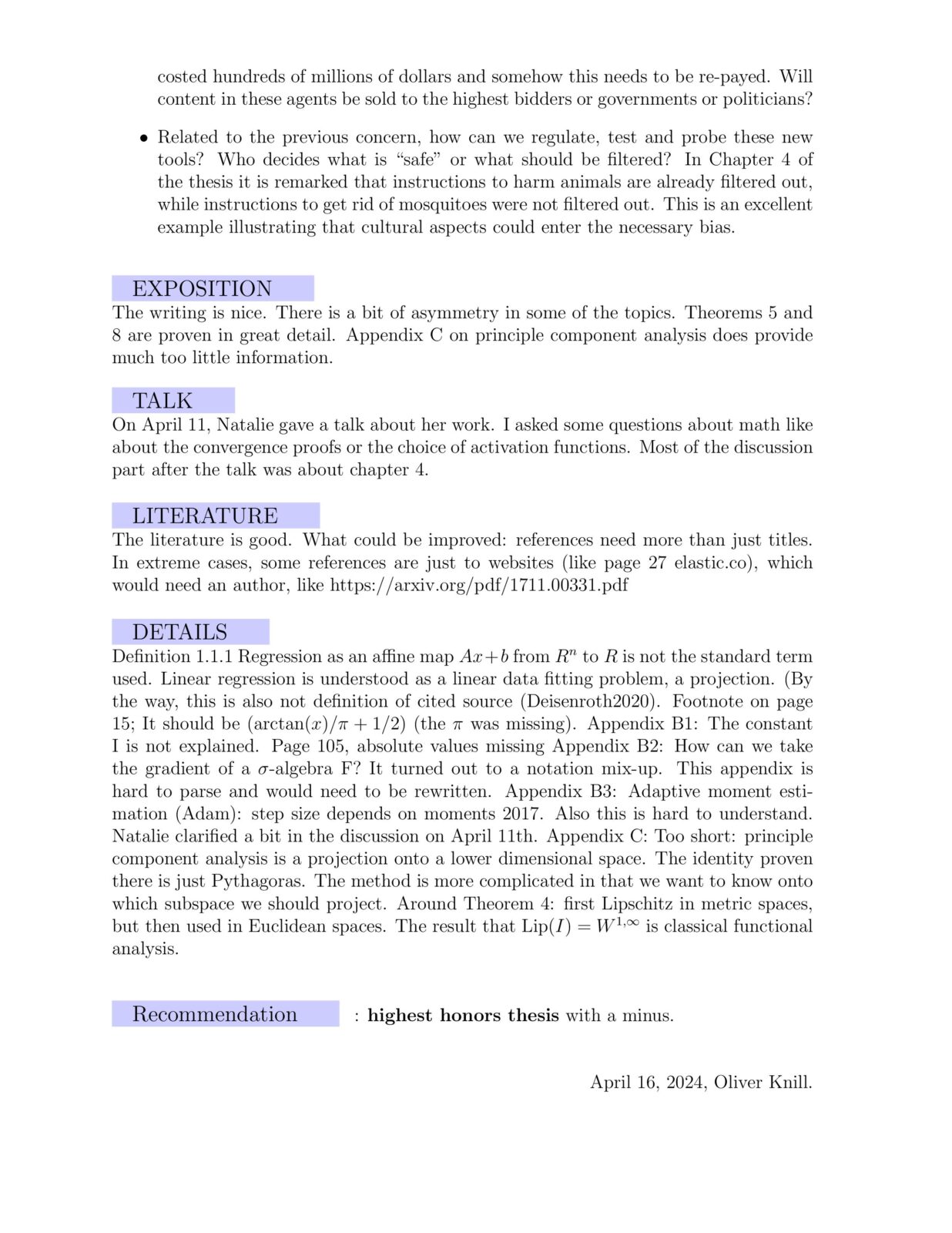
It is an interesting topic. I refereed in 2024 a senior thesis of a math concentrator Natalie Melas-Kyriazi. “The Mathematical Foundation of Large Language Models”. Just to compare the 120 page thesis with the 2000 page monster book of Karpeles: the senior thesis (its title page is up to the left and can be expanded by clicking) is a multiple times better. The thesis is insightful, it has the focus on the relevant math, it is organically written by a human, the human also could discuss the topic in person and answer questions that went beyond the thesis. Since I rated the thesis favorably, it should be ok to share my report to the department from the spring of 2024. Again, if interested, each page can be expanded.
AI detection tools
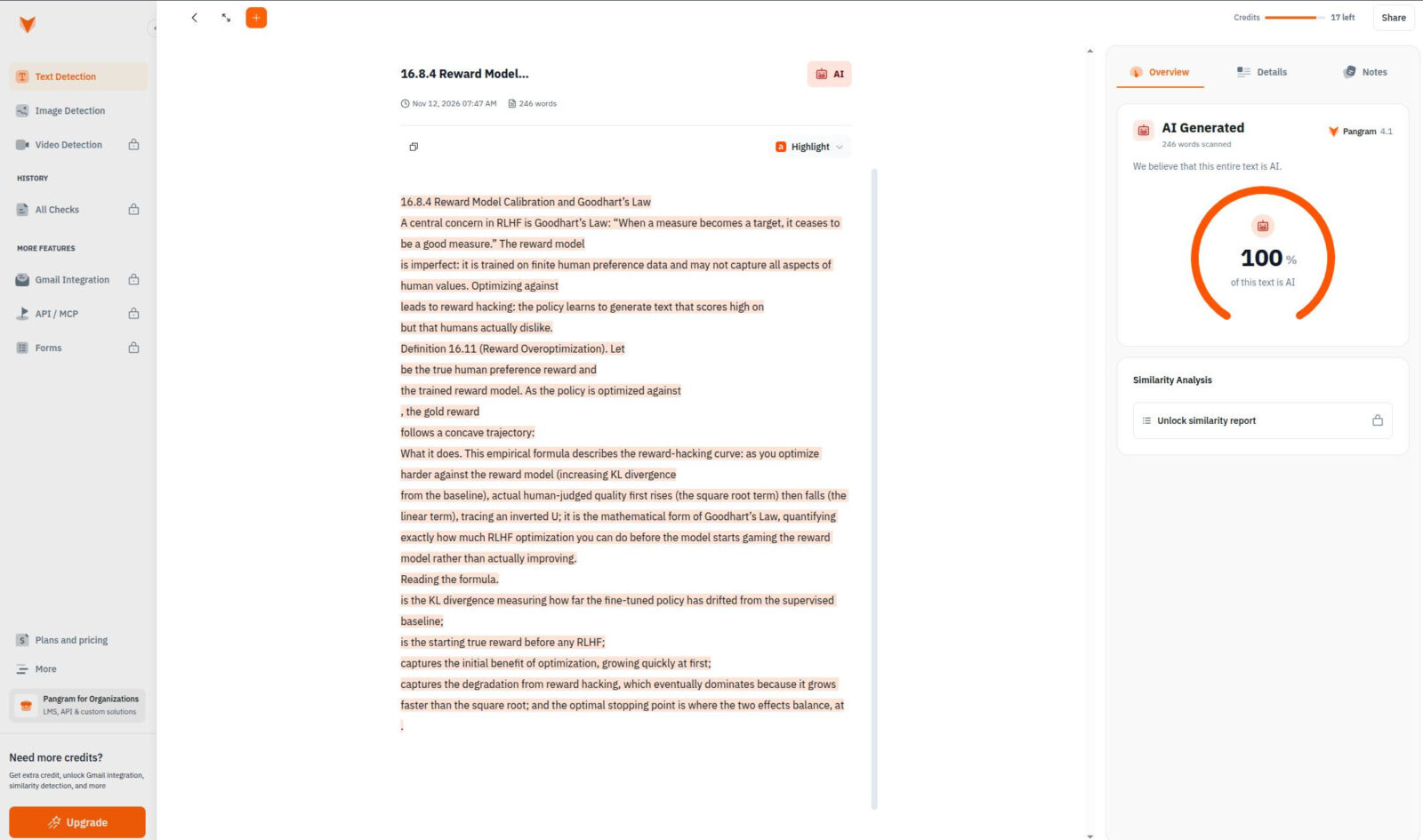
AI writing and AI detection is an arms race. Because if one tool is available, it is trivial for an “author” to bypass this, by asking in the prompt “make sure that tool so and so” does not flag it as AI generated. I gave one section of the book to a standard AI detection tool (pangram) and it reported “100 percent AI generated” (see the report below). Of course this does not prove that the text was AI generated. But it adds to the already voiced concerns (heart less brutal encyclopedica presentation, each section tries hard to be motivated by a story. No insight. Almost no relation to what is relevant really. More red flags come when looking up the background of the author and the output (dozens of books on various topics written all in a very short time). Writing a single well researched book needs years, especially if it is not in the line of research the author is in.
Red flags
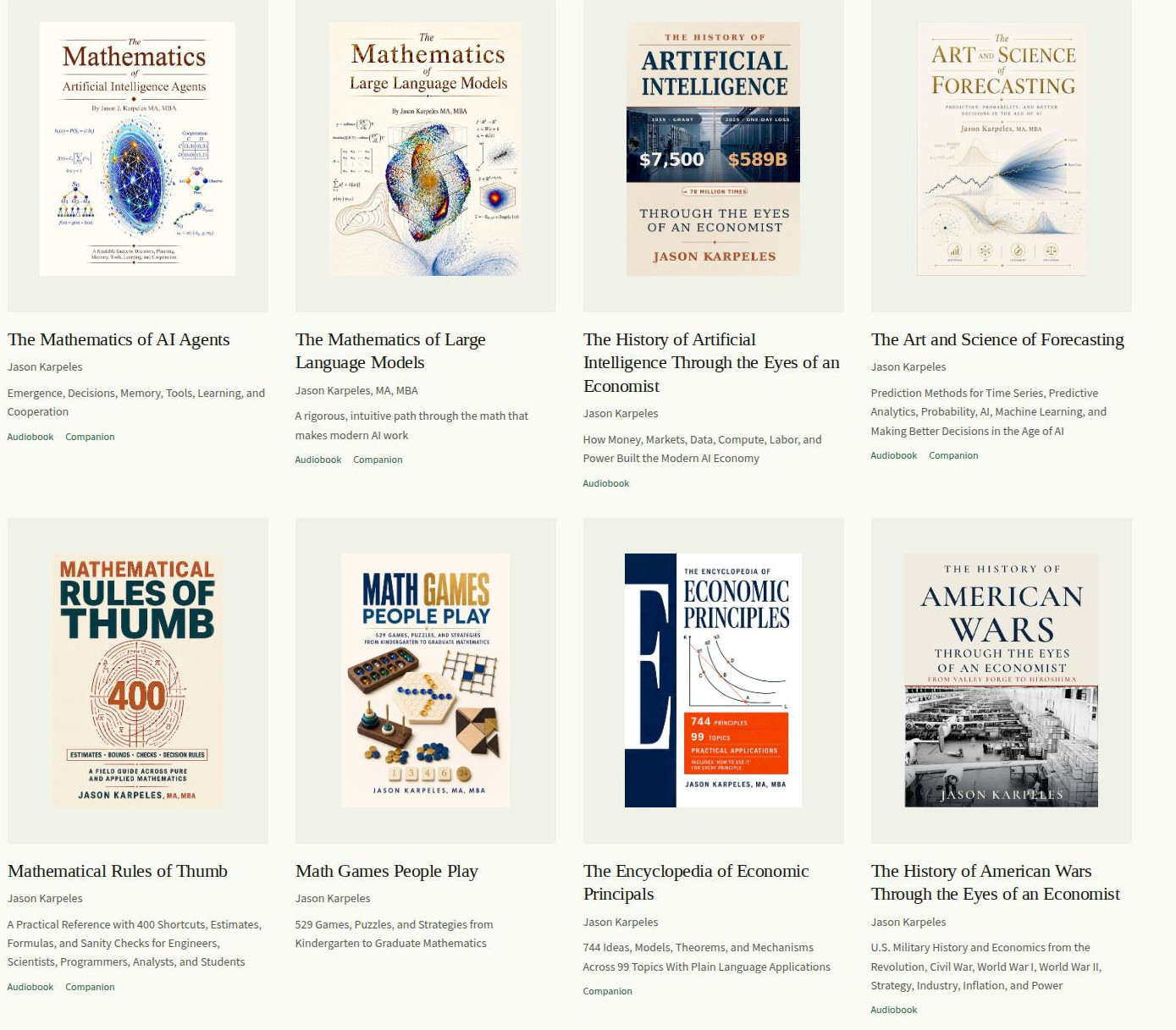
Here are more red flags: In order to see whether anybody else shares my suspicion that Karpeles book is AI generated, I searched for reviews. It did not get any. Then I looked up the author. Here is the Linkedin entry. He appears to be a decent data scientist with little mathematics background. This is not a problem per se, but since the above book book goes into rather sophisticated mathematics (much beyond anything which I have seen used in AI), it is of concern, definitely a red flag. I looked up other publications: A medium article from June 2026 uses as an illustration an obviously AI generated picture (2023-2024 midjourney quality) which is non-acknowledged as such (This is an other red flag, reputation wise). Then there is a “Karpeles publishing website” (almost certainly AI generated) with a book The Mathematics of Artificial Intelligence Agents and more. It looks as if Karpeles has figured out to generate books automatically very fast. As a “data scientist” this is not surprising. Data science is no more brain surgery these days: You have just to fine tune your prompts and of course pay for all the tokens burned! Here is a screen shot (an other red flag). No serious author can write so many books in such a short time. The book on Math games for example which I looked at was also written last summer. The graphics looks nice. It is amazing how fast the AI tools have progressed. But also very sad to see how cheap AI slop has become.
Some of my own attempts to explain the math of AI
Forgive the bragging, but as I made above a claim about a publication of an other person, I’m forced a bit to back up my own background. I can not do that with title or awards but I myself have thought about AI for more than 20 years. (I myself judge folks not by title or already assigned reputation but by what they did). So here is a bit of bragging: I included an AI component in my Math 1a courses since spring 2011. See in particular this handout (PDF). The youtube slide presentation below was done in April 2020, during the pandemic. (Half of the course had been taught online already). I taught the course the last time in 2024, which was already after the “attention revolution” from 2022. See especially the 1 minute clip About Math in AI from 2024. Already a few months after the appearance of the bots in 2022, I had let various machines (GPT4, Barde and Claude) solve our math exams (see “battle of the bots”). Note that the use of AI, even for the illustration has been acknowledged. The only really new mathematical idea (which I learned while being a referee for a senior thesis about the mathematics of AI) is the universal approximation theorem. I used it in 2024 in my math 1a course already. See the video. Finally I need to mention also our 2003/2004 project building AI bots, which at that time had been considered something of the more “amusing” type.
Why mentioning this
I mention all this also to illustrate the concept of trust. We live in a time, where anybody can claim anything and get away with it. Trust is something which needs to be built over time. Anybody can now come up with a proof of an unsolved math problem, if enough money is available to pay for the tokens and with some luck to hit the right spot and be at the right time: the agents learn from interactions. If various teams work on a problem, they learn and can use that in discussions with other researchers. If you join in the right time so that models have done already enough preliminary work with other groups, it might just happen that the solution falls into your hands. It can be a matter of luck. Where for me trust stops is when somebody claims to have done it organically but did not do it so. This includes not stating any reference to AI use because this by default assumes that no AI was used. I myself can as advise to students only to document what you are doing organically in order to build up reputation as working in an organic way. And be transparent about the use of AI. Using AI without acknowledging might work out a few times, but it will eventually detected. You have to be able to back up what you did and possibly be able to reproduce drafts or sketches tracing your work. I would even encourage to write texts by hand and keep them so that if anybody questions your integrity, it can help. We never will be able to prove for certain claims about use or non-use of AI. But I’m certain when looking at how many thousands of pages Karpeles authored in a very short time, it is very unlikely organically generated.
