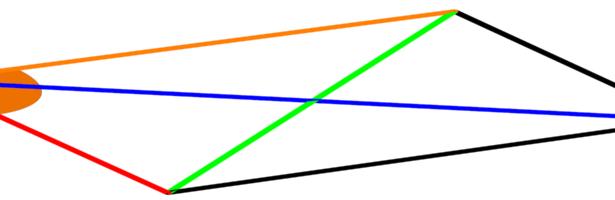
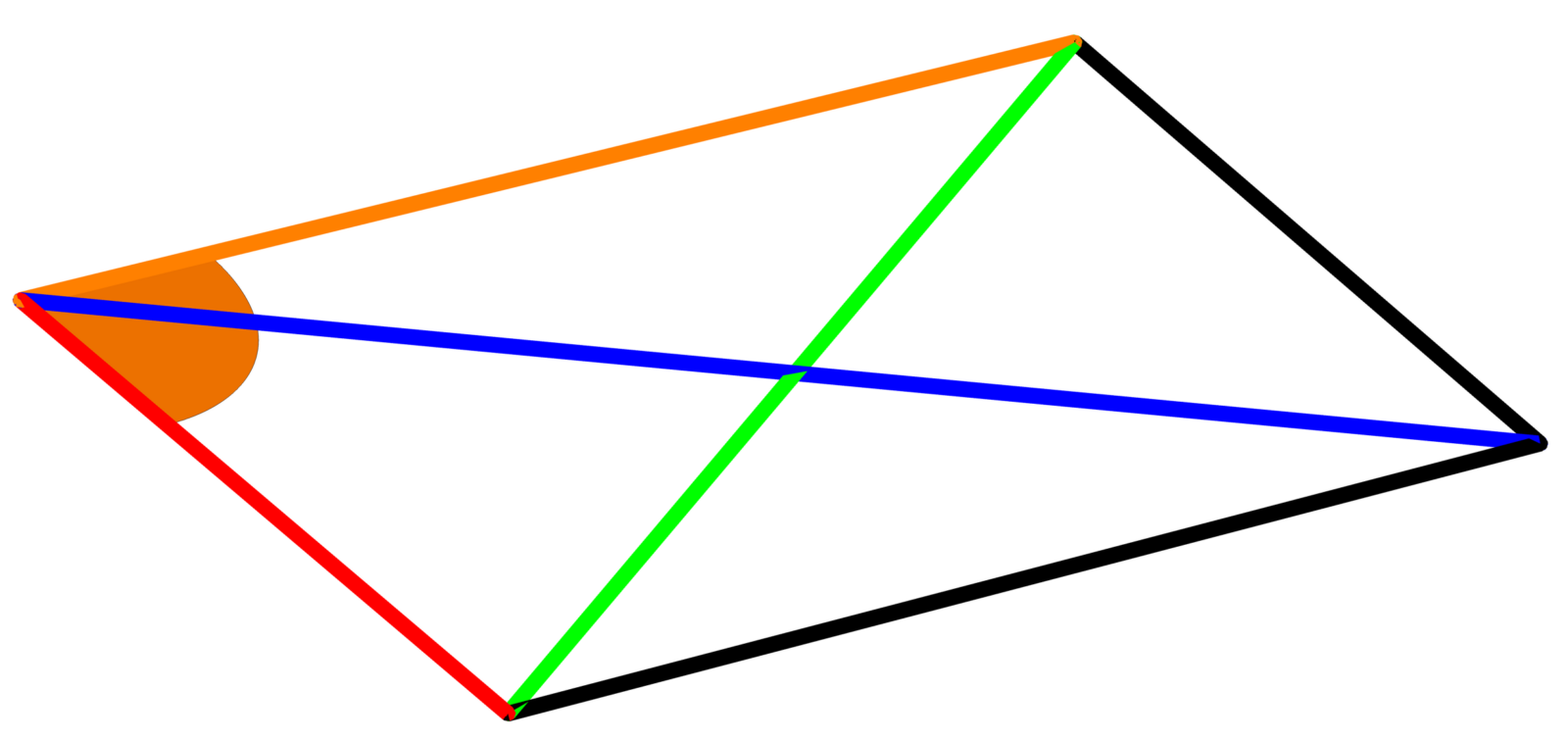
The Polarization identity for quadratic forms like inner products is also known as the parallelogram law. It is very important and always a good teaching moment in a multi-variable calculus course. It is more than just an identity. It tells that if know “lengths”, then we can recover “angles”. All the geometry in a Hilbert space is determined by the norm. The identity is the almost trivial algebraic . It implies for example that for random variables, knowing the variance determines correlations: . In differential geometry, the identity gives that knowing the Ricci tensor evaluated on pairs of the same vectors suffices to get the Ricci tensor for all v. This insight helps to get reasonable notions of Ricci tensor in finite structures like graphs, where it is a quantity attached to edges of the graph. Similarly also the metric tensor g, which also is a bilinear form at every point.
In order to generalize this identity to n-linear forms, introduce and write the above parallelogram identity as which is obviously the same, as we just doubled the sum. But now, we have a sum that is symmetric with respect to permutations of the variables so that the result has to be a multiple of as each term is homogeneous of degree 2. Once we understand this, it is easy to generalize this to higher dimensions. The formula holds in any commutative ring with 1. I called it in the video the polarization identity in dimension n. (Better would be Polarization identity for degree n). It is an identity which holds in any ring and are elements in the ring. Note that they can agree. We can for example in the degree 3 case write . The identity allows to write any monomial of degree n in the ring as a sum or difference of powers of n. While the identity is not deep, it is useful.
Polarization Identity: Let be elements in a commutative ring with 1, then . Every monomial in the ring of degree n can be written as a difference of sums of powers of n.
The proof is straightforward. As in the degree 2 case, note that the left hand side is symmetric and homogeneous of degree n so that it has to be a multiple C of . To get the constant C, plug in and expand and simplify the sum. It reduces to show that . To simplify this, use that is for only nonzero for , where it is .
We were interested in the polarization identity because we need to write in any k-form f (with ) as a linear combination of inner derivative , where $latex $g$ is a (k+1)-form, invariant under the flow of a vector field , meaning . For example, in , the 1-form is equal to , where and . So, in order to get this in dimension q=3, we need to write any polynomial of degree as a sum of polynomials that can be expressed using 2 variables only. Polarization does the job because we can write as a sum of polynomials of the form which allows in each of the cases to find a constant vector field X, which is parallel to the plane . Change coordinates so that is is x=0 and X=(1,0,0) so that does the job. Polarization allows to write a polynomial as sum of polynomials, where each monomial in the sum can in some coordinate system be written with one variable less.
This now allows to show that if the strong Huygens principle works for (k+1)-forms, then it works for k-forms. The above polarization trick shows that every k-form can be written as a sum of , where . For such a form, we have, using the Cartan magic formula and and the fact that all commute with (if vector field is parallel (constant)) the following computation . So, also only depends on points that are distance away from .



![{\rm Var}[X+Y] - {\rm Var}[X-Y] = 4 {\rm Cov}[X,Y]](https://s0.wp.com/latex.php?latex=%7B%5Crm+Var%7D%5BX%2BY%5D+-+%7B%5Crm+Var%7D%5BX-Y%5D+%3D+4+%7B%5Crm+Cov%7D%5BX%2CY%5D&bg=ffffff&fg=000000&s=0 "{\rm Var}[X+Y] - {\rm Var}[X-Y] = 4 {\rm Cov}[X,Y]")


