Are all 2-divisible Abelian groups natural? In 2-divisible groups, we can divide by 2. This is a big question and it appears to be a big cardinality problem. The video below explains this a bit. If one learns group theory one can have the impression that “abelian groups are boring”. After all there is s imple fundamental theorem about finite abelian groups which tells that such a group is a direct sum of cyclic groups of prime power. For finitely generated abelian groups, there can also be finitely many factors of integer groups. This is mirroed in the Abelian Lie group case, where in the compact connected case, we only have tori, while in the non-compact, connected case we have cylinders. For a person like me having grown up with the 15 puzzle or Rubik’s cube, the abelian puzzles are a trivial puzzles. Here is a famous example, the lights-out puzzle (I wrote once in 1999 in Javascript). The finite case often reduces to the Chinese remainder theorem. I had once fun with a “multivariable chinese remainder theorem”, which is very interesting and not as easy (but still “too trivial” for referees having looked at it).
The first time, I encountered myself a group that is not that familiar was when meeting the dyadic group of integers when writing my thesis. I had been excited to be able to factor a random Jacobi matrix L (Jacobi operator valued random variable defined by a measure preserving automorphism of a probability space which is simple element in the non-abelian crossed product von Neumann algebra . I was very excited and still proud to figure out that for any constant away from the spectrum, we can write , where is an other Jacobi matrix, but over a renormalized dynamical system, the 2:1 integral extension of . This new dynamical system lives on a doubled copy of the probability space and satisfies . It is easy to see that in the metric $d(T_1,T_2)=P[ \{ T_1(x) \neq T_2(x) \}]$, the map is a contraction so that by the Banach fixed point theorem, there is exactly one fixed point of . This is the von Neumann-Kakutani system, or adding machine. It is the group translation on the compact topological group of the dyadic integers. This group is remarkable, because it is compact and not 2-divisible. You can not divide by 2. There are smallest units. It is a quantized space, similarly as . Its Pontryagin dual is the Pruefer group which is also very nice as it is the spectrum of the ergodic dynamical system $latex . Group translations always have discrete spectrum and so are “integrable sytsems”. One can compute the future of an orbit exactly. I talked once in Birmingham (Alabama) about notions of integrability, at a time (2002) and still now, I find that that spectral definition of integrability is clear cut, simple, general and nice: “A topological dynamical system is defined to be integrable if for every invariant measure the corresponding measure preserving system has pure point spectrum” . It is general, works for systems with multi-dimensional time like tyling dynamical systems, differential equations, partial differential equations etc. Speaking of under appreciated math (…), here is a link to a theorem of mine which shows that any Hamiltonian system (even infinite dimensional ones) can be perturbed slightly to have weakly mixing invariant toris (and so are not-integrable!)
There are many nice gems hidden in the context of the dyadic group or Pruefer group. The group for example is a nice example to explain the notion of “localization”. The story is usually told in the context of rings but it also works in the even simpler case of Abelian groups. As we can not divide in , why not extend the structure so that we can divide by ? This is similar to other situations in arithemetic, where we for example wanted to take square roots and so introduced the imaginary number . Here we want to divide by and so need to introduce numbers like 1/2, 3/2, -1/2, etc. But now once we have these numbers we need to be able to divide again. We end up with all rational numbers . The set of all thesse numbers is then denoted . If we take these numbers modulo , we get the Pruefer group , the dual of the dyadic group. Before we get to the solenoid, just a remark that the map for random Jacobi operators leads to Jacobi operators over the von Neumann Kakutani systems and these operators have their spectrum on the Julia set of the quadratic map . They are in some sense quantum julia sets. There was little interest back then. This is illustrated by a story, I told already: at the Hillerod converence 1993, I gave a talk about this and there were just 2 in the audience. One was a conference buddy and friend who felt compelled to support me and the chairperson of the section. (One must say that there were parallel sessions and one of the talk was about local connectivity of Julia sets),and also, the main lectures already took up enormous times prompting many mathematicians to skip those or discuss things in smaller groups.)
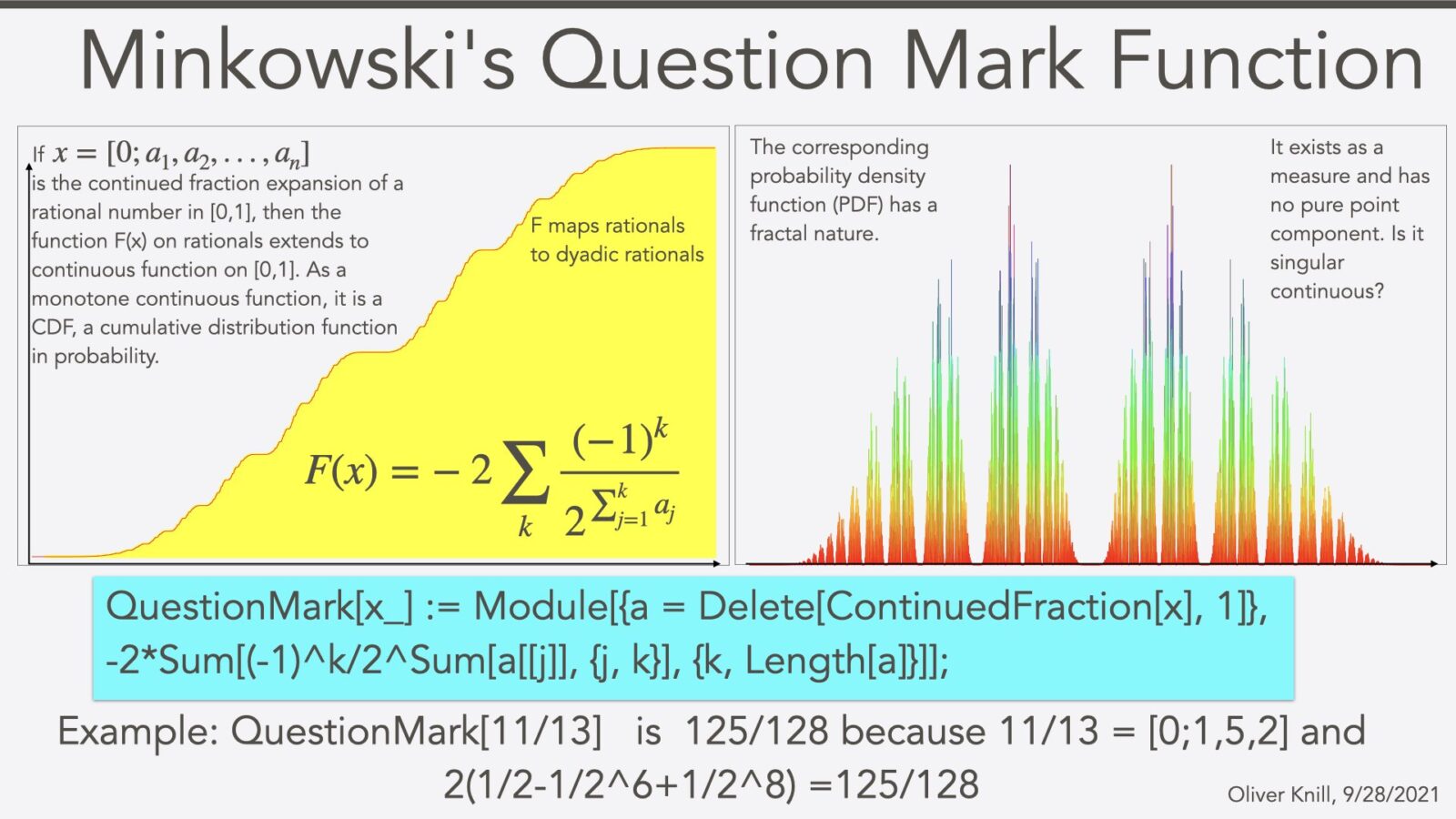
The group of dyadic rational numbers is interesting for many reasons. I tweeted once in 2021 about the question mark function. It is interesting as it maps rationals to dyadic rationals! It is a map from . It is a CDF (cumulative distribution function in probability theory and it is probably singular continuous. We only know that it has no point component. But the dual of the dyadic rationals turned up in my own life much earlier: during lectures of Oscar Lanford about dynamical systems. Here are the notes of Lanford which he planned to write as a book. Unfortunately, it got never published. My own handwritten notes of this course are here. This was a time, when we students would all (even with perfect notes available) write down our own notes. I can only recommend that still today in a time where mathematics is taken over by machines. You own it more, if you write it. You own it even more, if you talk about it. One reason, why I do these 10 minute talks as below. (My family calls them “talking to myself” events, which is good characterization.).
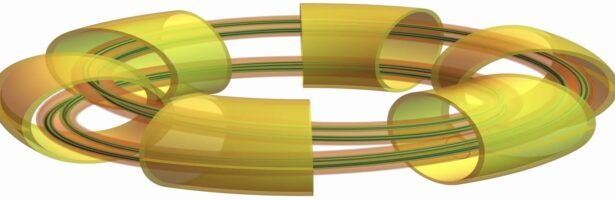
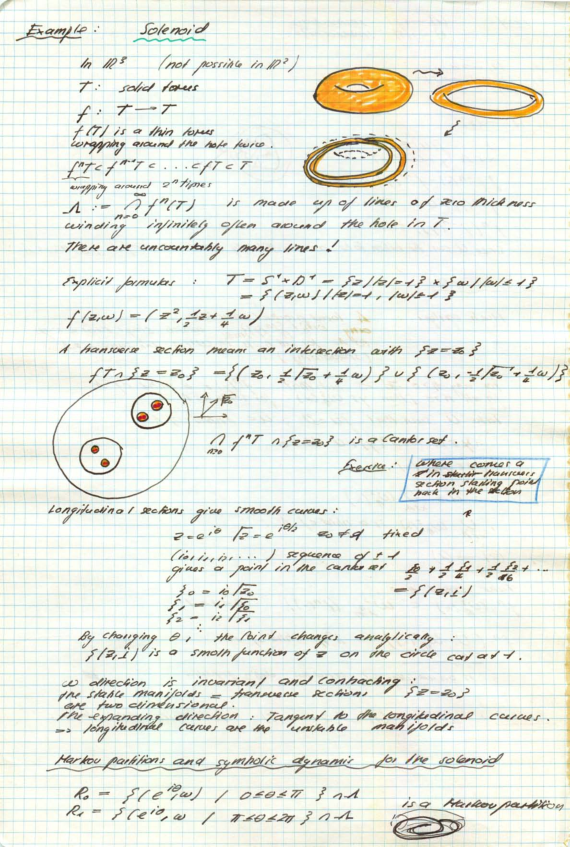
Any way, back to the dyadic rationals. Much more exciting (geometrically) is the dual group which is the solenoid. It is also called the Smale-Williams attractor from a good old time in dynamical systems, where major ideas were more important than 300 page proofs of an existence theorem of a dynamical system, proven by a machine. Strange attractors have been introduce by Ruelle and Takens (with a juicy story as the paper had been rejected by the “mainstream math world” but Ruelle as the editor of a journal could push it through. Lanford liked that system very much. I still remember how he lit up when talking about it. The reason is that it is strange attractor, where we understand everything. We can compute its Hausdorff dimension, we can compute the entropy, we can compute all Lyapunov exponents. It is a uniformly hyperbolic dynamical system. I of course was back then very interested in that because I had already tried then in 1987 to prove positive Lyapunov exponents in non-uniform hyperbolic situations like the Standard map or the Stoermer problem (the problem of understanding the motion of a single charged particle in an dipol field). It is a non-integrable 1-body problem! (I still admire Moser’s taste today by suggesting this system as a senior thesis project. It is a gorgeous problem: historically, related to physics, related to dynamical systems, related to ergodic theory, related to KAM theory, related to the Aurora Borealis spectacle. To the left, you see the page on my notes where the solenoid was discussed by Lanford in 1987.



![\mathbb{Z}[1/2]/\mathbb{Z}](https://s0.wp.com/latex.php?latex=%5Cmathbb%7BZ%7D%5B1%2F2%5D%2F%5Cmathbb%7BZ%7D&bg=ffffff&fg=000000&s=0 "\mathbb{Z}[1/2]/\mathbb{Z}")
![\mathbb{Z}[1/2]](https://s0.wp.com/latex.php?latex=%5Cmathbb%7BZ%7D%5B1%2F2%5D&bg=ffffff&fg=000000&s=0 "\mathbb{Z}[1/2]")


![Z[1/2]](https://s0.wp.com/latex.php?latex=Z%5B1%2F2%5D&bg=ffffff&fg=000000&s=0 "Z[1/2]")


![\mathbb{Q} \to \mathbb{Z}[1/2]](https://s0.wp.com/latex.php?latex=%5Cmathbb%7BQ%7D+%5Cto+%5Cmathbb%7BZ%7D%5B1%2F2%5D&bg=ffffff&fg=000000&s=0 "\mathbb{Q} \to \mathbb{Z}[1/2]")

