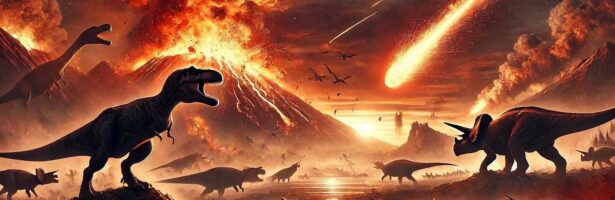
it is evident that we live in a time of extremely fast change with respect to epistemology, the way how we acquire known and gain new information. As a dinosaur, who has seen several “meteor impacts” (new math, math wars, the rise of the web, the moocs wars and now the AI war), I like to think back to all these “potential extinction events’. The latest one might actually be the end of us dinosaurs … It does not makes sense to speculate too much. Let me just add here a few personal stories:
- While in primary school, calculators appeared. My father, a middle school teacher then, bought one of these early calculators (which were expensive, close a thousand dollars probably). The fancy version my father had, even included a square root function. I once impressed my father because I had memorized the square root of 99 which is 9.9498743. My parents knew about the temptations of media and technology. In the first few years of my childhood, they did not buy a TV (my grandmother had one, and she called it the “electronic grandmother”, we of course liked to go there and watch Lassie, Bonanza or even the news). Later, we would have a TV at home but were allowed only one hour per week. We chose “Raumschiff Enterprise”. Anyway, I’m grateful for this “restriction to technology” as a young child. Actually at that point, educators knew already that TV could already make you stupid. Nothing changed today, AI can make you stupid, as data already have proven. Kids who did use AI are very clearly worse in proctored exams. Moral: It can make sense sometimes to restrict access to technology. As in TV it is probably pointless to enforce this by any government or regulation but we just have to accept that doping eventually makes you weaker (after a temporary boost comes the fall, usually a deep fall).
- As a high school student, I investigated partitions on my own. I formulated the question coming from daily life: how many different ways can I pay a certain amount of money if the coins are known. Like 30=25+5=10+10+10 = 5+5+10+10+10+10=5+5+5+5+10+10+10, ….if we would use US money. I investigated the question without talking to a single person with only one reference point, an encyclopedia entry in a Harry Deutsch handbook on math. At the end, I showed it to my high school teacher Roland staerk and also visited the ETH library (micofilm time) and found out that part of what i discovered had been discovered already. Staerk told me about “generating functions” and one of the theorems I found in a book on partitons. I’m so happy that I did not interact with my teacher before, and did not consult literature as it would have immediately killed all my efforts. I would also later keep this philosophy. If you have an idea, think about it first yourself, don’t immedialy ask an expert. It comes with a caveat however as the next story shows. Moral: it can makes sense in a discovery process to isolate yourself.
- As a first year student at ETH, I still tried to entertain the philosophy to find things myself (this is called IBL inquiry based learning now). I spent also immense time on programming on the early macintosh computers. And we went hiking in the Finnland lake area and lapland for weeks before the exam. In any case, I did not progress fast enough to really prepare well for the exam and did not do well in the first ‘syear exams” which were entiry hold in person with oral exams directly with the prof, even in calculus and linear algebra. Some brutal questions there. I was with three others and one of them was asked under which conditions two matrices commute (i would not have been able to answer that). Moral: there are time, where you need to soak up information fast. And college is such a time, forget about creativity for a while. It is sometimes just important to learn, learn and absorb. Creativity will grow on a solid knowledge.
- As a sophomore student at ETH, I was lucky to see the lecture series ” limits of knowledge” of Paul Feyerabend. I admired his courage to defend an idea against everybody else. I think there was almost nobody who agreed with his “everything goes” anarchy. Everybody attacked Feyerabend. But that made the event so memorable and interesting. There is nothing more boring than a a discussion, where everybody agrees. This is maybe also the reason why Harvard dropped from being number 1 to 5: there is too much uniformity of thought. It sterelizes a university. I completed yesterday the mandatory online training on “FY27 Creating a Community Free of Discrimination, Bullying, and Sexual Harassment” and free speach and free expression is strongly put into the values. Maybe there will be more diversity of thought in the future. Moral: there is no universal approach to epistemology. The landscape can change.
- When writing my undergraduate thesis, there was no latex, no web look up of course. There were libraries! I had a technique to look into the future and I’m still today pretty proud about it as even later in grad school, I would be astounded that nobody knew about it. The problem was: assume you knew a paper that was in your interest and you wanted to find more recent literature to it. How would you find it? The key was the “citation index”. There was an entire hallway full of those, the pages were extremely thin almost transparent, hundrets of thousands of pages enscribed very densly. I spent many afternoons there, if not writing code to simulate things (even writing a printer driver for my atari from scratch! using just a Pascal manual and the manual for the needle printer). I think even Moser was impressed about the literature list, I could get. Moral: being creative in finding out what has been done can be interesting already. The problem today is of course that if we look up information we also might look up answers.
- Also as a grad student, we had no web yet. We would gopher around or telnet into machines all over the world, or into the printers, the first webbrowser Mosaic appeared just about when I would wrap up my thesis. There was fortunately already latex, but printing things out was still a pain. I had a 450 page thesis and I complained to Lanford “that it was a nightmare to print it out!’ Lanford sarcastically replied “Imagine the nightmare to read it!”. I feel now for him. the thesis is definitely a bit hard to read, even for me now… Moral: technologies changes are fast, having technologies like bibtex or latex was a relief upon ‘pixel based’ writing programs like signum, I used for my undergraduate thesis or “IBM wheel type writers” for my high school project. But the thinking was still done on our own.
- My postdoc time at Caltech was exciting but had also frustrations. There were some folks around (like Yoram Last or Svetlana Jitomirskaya) and of course Barry Simon, which were in a completely other league mathematics wise. I feel this today, if I ask something to GPT 5.6 sol. Back then, these experts in spectral theory had just thought about the subject much longer and acquired creativity techniques i had not. Now, these machines have internalized thousands of math books. They know the classification of finite simple groups for example (i know that from a personal communication with GPT 5.6 sol) as the machines help already to reduce the proof to a few hundred pages. They probably know therefore the subject already better than Michael Aschbacher, one of the world top experts in group theory. i remember, I was invited to a chat with Barry and Svetlana about some project. I immediately bailed out. There was no chance that I could contribute anything meaningful. Fortunately Bert Hof soon arrived and we could work together and Barry on something much simpler. Maybe I did a mistake not to get more involved in the spectral theory group there but it is like in climbing. I never liked climbing in too difficulty grades which were beyond my abilities. Not that I would not try, like in “climbing arenas like Bellinzona” but I was not only once falling there. Still today I maintain: it makes sense to choose work in a difficulty range, that is appropriate. I like the “genuss kletterei” (climbing with joy) and not “dura dura” (hard-hard) .
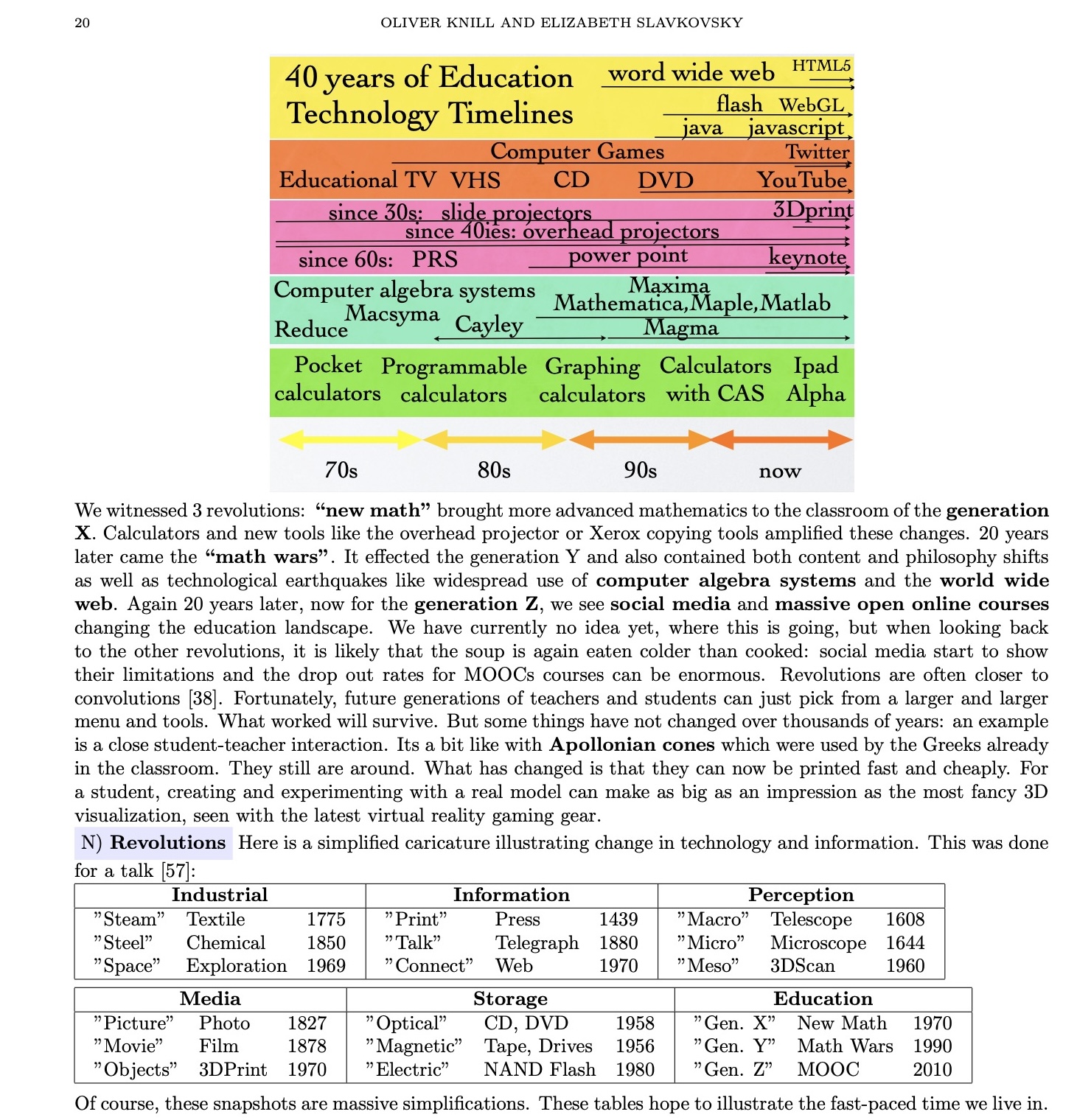
- In my work with Liz on “Illustrating math using 3D printers” we already described a bit revolutions for Gen X (new math) , Gen Y (math wars) , Gen Z (mooc war), Now we could add Gen Alpha (AI wars). The mooc wars were a short one and peacefully resolved: effective online teaching died faster than anticipated. The pandemic illustrated how ineffective even modern technology is. Not that there is no use, but not for credit. Doing something for credit requires in person teaching. More recently, the online math placement tests (which I myself 20 years ago tried to fight to go online, I was then already aware that anything could be looked up easily on google), have been enhanced again with local in person tests. The AI revolution completely destroyed the ability to test online. Things like the lockdown browsers might work when still proctored, it is trivial to bypass them at home. Every kid can figure that out. Educators are sometimes so naive. Anyway: the short MOOC war shows that sometimes seemingly disruptive new ways to acquire information can die.
- Today we are in the middle of a major change. A meteroite just has hit two days ago. There were smaller impacts earlier in the summer already but having solved a major difficult problem in mathematics is a big event. It might be an extinction event. It is not clear whether we dinosaurs will survive it. At the moment it is not so clear. The clouds are still forming. Forbidding or restricting the technology would be a mistake as there would just be “deepseek” events a few months later. We mathematicians are in a serious meteor shower now and do not know whether we will survive this. Maybe mathematics will become a bit of a game like chess or sports events, where technology is forbidden. Or maybe we will learn how to deal with the situation in a meaningful way. Anyway “we are in a seismic shift ot epistemology” and have no idea what is going to happen, even in one year. I myself think about doing math in a different way again, like doing some things completely isolated. I already religiously refused to use any AI for anything, even proofreading or spell checking my “elements of finite geometry”. AI was not allowed to touch this. I hope I will be able to keep this up also when working on the second batch next summer.
Here is part of a page from our work from 2013. It is only 13 years now, but it looks like from an other century! We cited that “revolutions” are often more like “convolutions”. I’m not sure at the moment with AI. This is more serious. The Nash equilibrium is that all nations try to develop stronger and stronger AI and that there will be no “weapons treaty”, even if we all will agree that it is devastating for the moral of any creative person. But who knows. We can not predict the future. Yuval Harari recently pointed out, that it is the fist time in history that we do not know and can not predict, what the world will look like in 10 years.