

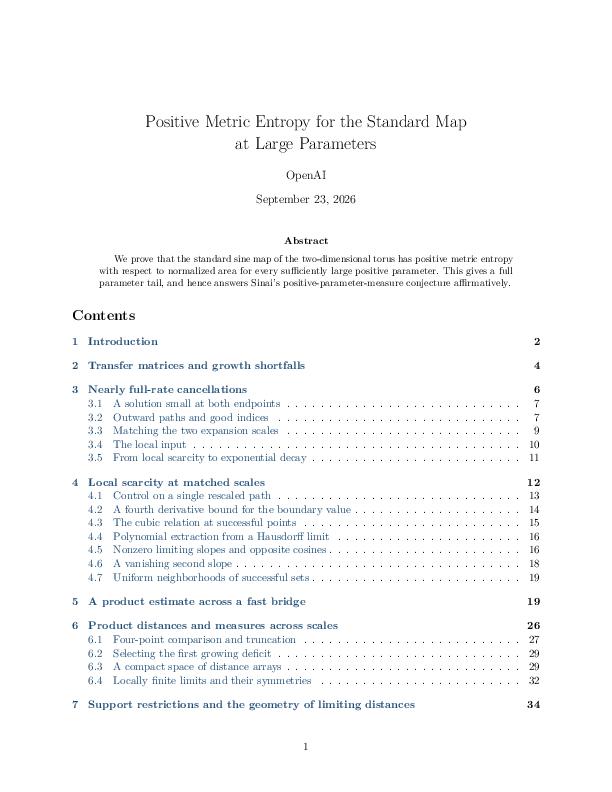


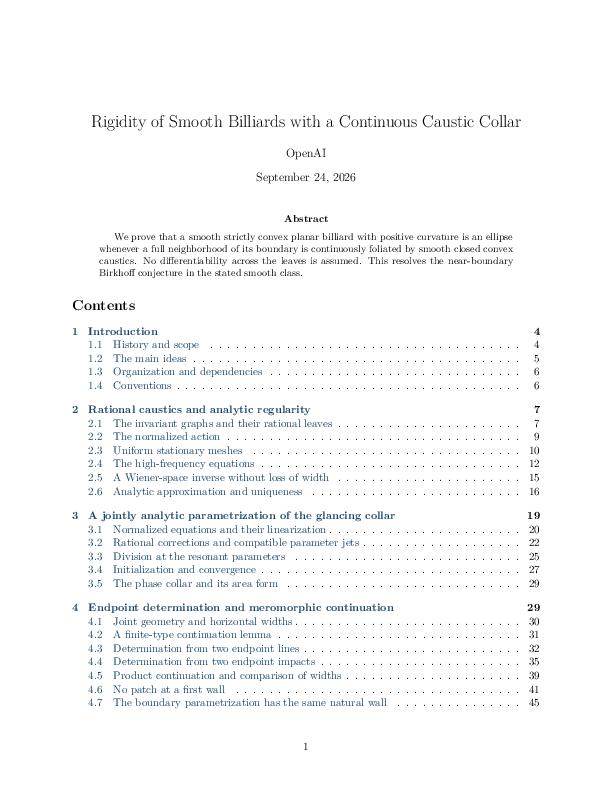
The September 8 event in mathematics was the solution to a millenium problem. Even more brutal (for me at least) is the October 6 announcement of the solution of hundreds of open mathematics problems. It is a slaughter house! One of them is the solution of a problem I had been working on for more than 10 years: the standard map T(x,y) = (2x-y+c sin(x),x) has positive entropy for large enough c. There are 722 manuscripts there. An other problem is a solution of the Poritski conjecture: integrable billiards are ellipses. The two problems also appear on my favorite list of open problems in Hamiltonian dynamics. There are also some results about polygonal billiards. One consolidation for mathematicians is that the solutions I have looked at until now are not what one would call “elegant”. I’m frankly not that interested even in what has been written by AI. Here is a link to my javascript animation of the standard map. It contains at the bottom some remark on one approach I had tried very early as a graduate student (embed it into an entire function in higher dimensional complex space and use plurisubharmonicity). I made once in 1999 a website, after spending 2 years almost entirely on this problem. At a time, when I believed to have a solution.
An other development is a new dump repository for AI slop math papers. It is called hexagon math. This is the current garbage bin for mathematical results obtained “for free” or as one of the foundars of the project wrote: results that “bubble up”. Maybe it is a good idea to take pressure from the ArXiv, which has been flooded by AI generated papers. It is not easy to keep up with all this. For me, the fall of two of my favorite problems (the Standard map problem and Birkhoff Billiard problem on which I both worked for years) is kind of sad. The good news is that every open problem solved produces 10 more open problems. For the standard map, the solution is (from what I saw until now) just plain ugly. Also for the Poritski conjecture, there should be a better way to see this. In the first case, we still do not know what happens for smaller c. The standard conjecture is that entropy bounded below by log(c/2). For the Poritski problem, one can ask similar questions in any dimension. Assume a smooth convex billiard in dimension d has the property that it is integrable in the sense that caustics foliate a neighborhood of the boundary, then it should be special, maybe even an ellipsoid. I’m actually less confident in higher dimensions and it could well be that some higher dimensional nice symmetric spaces also produce integrable billiards. I myself worked on caustics in this paper including also some three dimensional billiards.
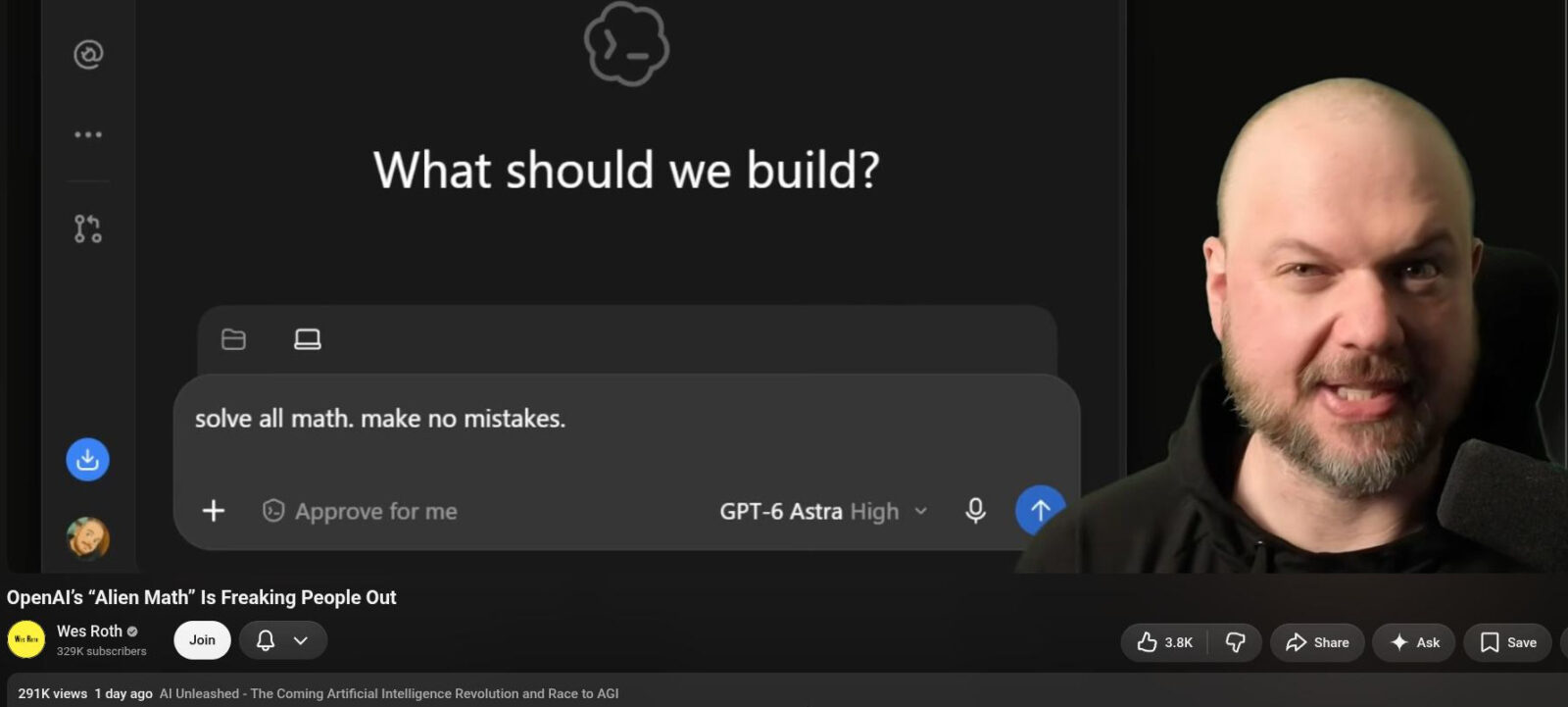
Update October 10, 2026: Alien math: a video on the October 6 event mentions Aaronson’s word Mathocalypse and the catchy story (quote from that blog) “Last night my 9-year-old son was taunting my wife, complexity theorist Dana Moshkovitz, as follows: “mommy, I heard you got cooked! I heard that a robot solved the math problem you worked on for your whole career! OOF!” While my son was being a brat, he also wasn’t wrong.” It is the right word. Now, we mathematicians appear to be “cooked”. An other word that has been floated is Slopocalypse which is a more broad expression, as it applies not only to math, but also to other fields like literature, music or art. For me, one of the consolidations (still) is that these works of OpenAI are just but ugly and tasteless. It takes a huge jab at mathematics, but the field is not dead yet. There will be some work that might enter the “proofs of the book” in the future. But at the moment, it feels like having a computer algebra system “solve” a difficult integral. Ugly mathematics of course is also prominent in almost all published mathematics done by humans. It is similar also in literature or music. There was never a time when more music, novels or mathematical papers have been written. But the overall quality in average has not only gone down, it has (as an arithmetic average) almost reached zero. There is still a lot of nice work around but it takes more time to find it. We live in a time, where a 5 year old toddler can write a novel, or opera or prove an unsolved mathematical problem, if given the tools (a subscription to some frontier AI models, payed by a rich uncle for example). What happened is brutal as the benchmarks have been shifted so much in such a short time. Even a year ago, proving a new theorem had been considered an achievement. Now, the work of the brightest folks in the field is drowned in avalanches of slop. This is not new. Technology has made lots of progress in the past. I myself have witnessed the transition from typewriters to computers writing text. When writing with a typewriter, things were much slower. Every typo had to be fixed with white tape or if a word was wrong had the effect to restart the page entirely. My first work in mathematics as a high school student was written like that. Computers helped. For my senior thesis, I wrote with a SIGNUM pixel based computer system on an atari. Then came Latex which accelerated the process. There was no problem to write a 400 page thesis. (I only complained to Lanford that it had been a nightmare to print, to which he replied with dry humor: imagine the nightmare to read it!). Now, we have machines write papers automatically and we can not even imagine the nightmare to read all this (or “digest” as has been said). What has happened with any technological advantage also is that the understanding has gone down. How many “developers” can write a program for a dozen computer programming languages from scratch without any manual or template, how many still know how to write postscript files by hand, or netppm pictures by hand, or HEX edit a binary, or program in assembly or look for memory leaks sources by hand in a C program. We might enter a time, where we have to ask, how many mathematicians can still read and write mathematical content without the help of an “assistant” giving them the summary, or can solve Putnam problems without a machine. Now, computer science and mathematics have just been easy targets for AI, the other fields are still coming too. I still don’t think that higher education has realized what is at stake. Delegating work away means devaluation its own relevance. When I came to Harvard in 2000, information technology was done much more locally, had local mail servers in the department, installed, patched, babysitted all our stuff locally. Not that this work has disappeared, it has been centralized now, much has been taken over by tech companies. Also for teaching, we had flirted or even used outside services like edfinity, alexa or questionmarks, google etc etc. And now, Big Tech has come for research. One can call this euphemistically as a “symbiosis”. It is also a fight for a piece of a profitable cake, an industry that has made regions like the Boston area the nice and prosperous place it is. I know that there are many smart folks around who can see the warning signs written on the wall. The surprise is (and I think it stumped everybody, especially AI experts), that things went to fast. Only a few years ago one has predicted that in 2050, machines would be able to write research level mathematics. Even this summer, a summit of some of the brightest minds stated that there is no danger that AI can do research level math soon. Then came September 8 and then came October 6. It had been easy to chalk off Navier Stokes as a singularity case, where extremely complicated partial differential equation models were just an easy target for AI that is not afraid of technical obstacles. But now, since October 8, one one can see complicated multi-scale analysis proofs. I still personally see these works as examples of “ugly math”. There is no doubt that we are at an extremely interesting time of science. The depression of seeing this happen is a bit compensated by the fact that I’m still able to witness this is a really interesting time for humanity. I myself see this also an opportunity for a new generation to reevaluate priorities and values.
