
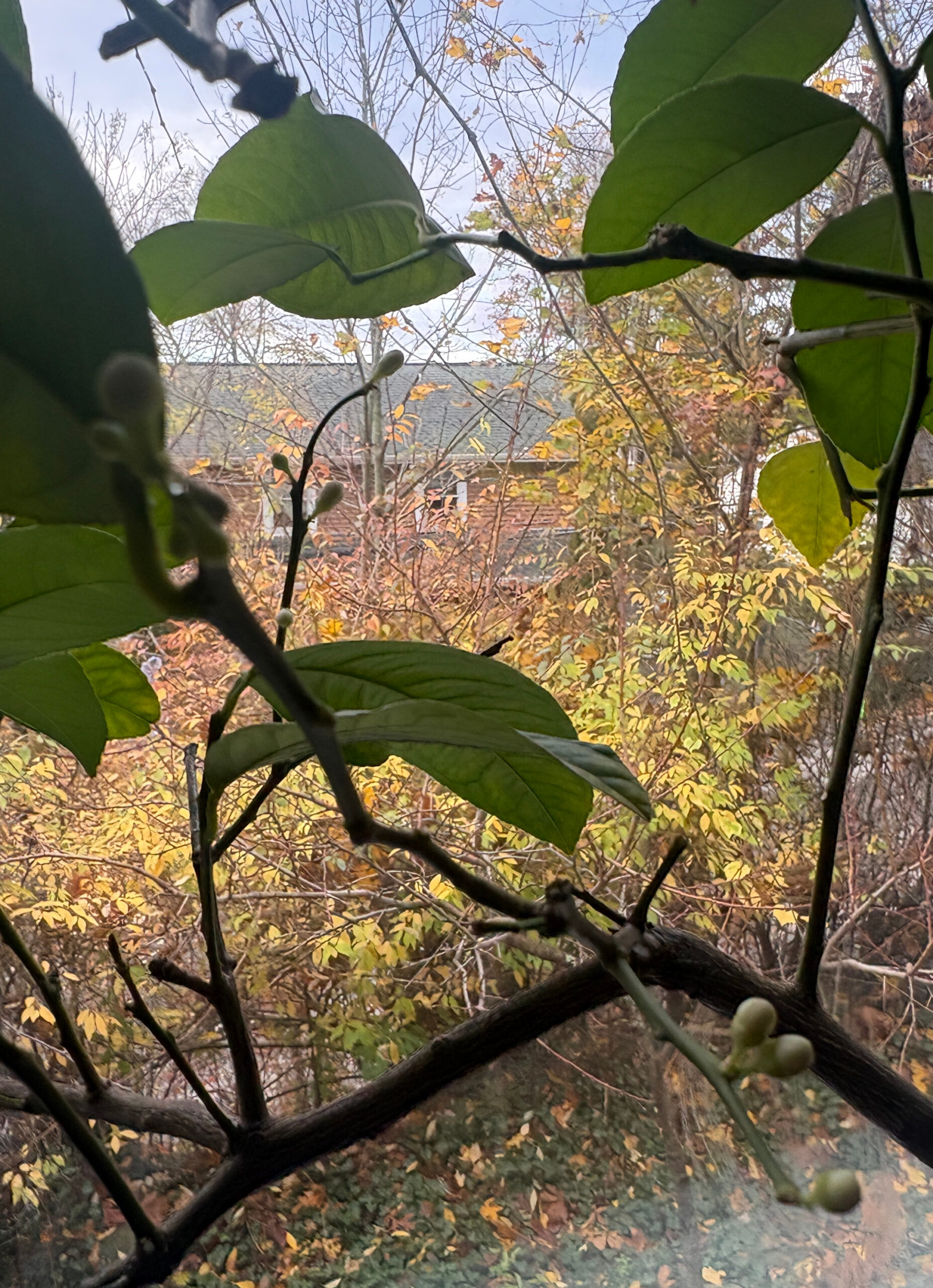


I myself feel very good by doing experiments and write everything from scratch. Start with a blank state and write some code. It does not have to be long. Half a dozen lines in a modern programming language not only look like a poem, it can establish much. I myself take pride about authoring something. It could completely melt away if the task was given to a machine. This is I believe one of the things the current “zeitgeist” does not understand: it is the “doing things” which is the source of purpose, not the “achieving” of things. And the “how” is also important. This applies everywhere, whether we are thinking, whether we are producing music or text or theorems. It matters how it is done. Our lemon tree at home at the moment has started to grow new flours. They are still tiny bulbs but in the spring, it will have lemons. I just took the picture to the right. What’s the point, one might ask. You can buy lemons in the super market and you don’t have to wait and work for it. It is the same today with proofs of theorems or art or music. We can “buy proofs” now from the shelf. Can you brag about it? No. Of course not. It just proves that you had enough money to buy it. We live in a time, where the purpose of our existence is renegotiated. And purpose is linked to “how something is done”.
Here is some code poem I used to experiment recently during my journey to find some sort of closure about the entropy problem I had been working on for decades (on and off of course). It boils down to a simple linear algebra question about the growth rate of matrices. It is a question in non-commutative probability theory, where random variables are no more commute and where averaging does not work. It is non-commutativity which makes the quantum worlds less intuitive too. The following experiment probes my “bold linear algebra question”. It tries to find permutations for which the Lyapunov exponent is as small as possible, then tunes things up by wiggling the individual entries in the cube. The conjecture is that for any fixed permutation, we can always pick points such that the Lyapunov exponent is larger than log(c/2). If this was true, then we could by upper semi continuity and Lax theorem get that the Lyapunov exponent of the cocycle over any area preserving map on the torus is larger or equal than log(c/2). Especially for the standard map. Making the problem harder by claiming it for ALL area preserving maps, washes away the difficulty to worry about the complexity of a particular map. It is the Laeuchli paradox in action: to prove something it can be much easier to prove something much harder. In the presentation from yesterday, I outline an other strategy to prove things: we only have to make sure that given a permutation T for which the estimate holds that we can adjust the values so that switching the first two entries in the permutation does not change the trace. Then we have established it for an other permutation. Since composing with cyclic permutations does not change the trace and because for the identity Herman’s dial gives the estimate, this would establish the “bold linear algebra statement”. I spent a lot of time during 1998/1999 with this finite problem, but had focused mostly on complex analytic techniques like Jensen’s formula or subharmonic averaging. it might be much simpler, if just use a gradient flow to get to situations where a flip becomes possible. So, here is the code. I do think it could still be possible (and be compatible with the proof of course) that somebody would find for small n some example, where things are tight as the argument only works if n is large enough so that exponential beats polynomial. The argument uses that the gradient flow on the manifold M where the Lyapunov exponent is log(c/2) reaches the surface N, where flipping is possible in a time that is exponentially small in n simply because the gradient of g projected to the tangent space of M is exponentially large. Working on the torus makes it possible to be true for all n. If we just look at permutations of n elements and look at the same problem it fails for small n, but appears to be ok for larger n.
c=4; cc=N[Log[c/2]];m=8;n=m^2; min=N[Log[c]];W=100; RandPerm[n_]:=Permute[Range[n],RandomPermutation[n]];
FlipPerm[t_]:=Module[{e=RandomSample[Range[n],2],s=t},s[[e[[2]]]]=t[[e[[1]]]];s[[e[[1]]]]=t[[e[[2]]]];s];
L[U_,X_]:=Module[{l=0,B=1.0*IdentityMatrix[2]},A[k_]:={{2+1.0*c*Cos[2Pi*(k+X[[k]])/m],-1},{1,0}};
   Do[B=A[U[[k]]].B; q=Tr[B];If[q>1,l=l+Log[q];B=B/q],{k,n}]; (l+Log[Abs[Tr[B]]])/n]; o=Table[1,{n}];
R:=Block[{},q=Max[Table[L[S,o*k/W],{k,W}]];If[q<min,min=q;T=S;Print[N[{n,cc,min}]]]]; T=S=RandPerm[n];
Print["Random shots into group:"];    Do[S=RandPerm[n];  R,{100 }];
Print["Annealing in group: "];        Do[S=FlipPerm[T];  R,{1000}]; Q=Table[L[T,o*k/W],{k,W}]; q=Max[Q];
Print["Adjust values in cube"]; k0=Position[Q,q][[1,1]]; X=k0*o/W; M=q;  RandPick:=RandomChoice[Range[n]];
   Do[a=RandPick;Y=X;Y[[a]]=Mod[X[[a]]+Random[]/W,1];q=L[T,Y];If[q>M,M=q;X=Y;Print[{n,cc,M}]],{10000}]
Print["Average over cube comparison"];  Sum[L[T,Table[Random[],{n}]],{2000}]/2000
Experiments play an important role in sciences. They keep us grounded. It is easy to be carried away with abstract constructs and ideas and speculations and beliefs. Experiments helps to throw away wrong ideas. And this is important because it is relatively easy to generate ideas. Not so easy is to generate ideas which hold up with reality and especially with experiments. Mathematicians do not value experiments as much as there are many examples, where experiments do not match with “reality”. If we take a gas of 1000 particles in a box divided into two chambers and start all particles in one part, then open the door, the gas will equidistribute. We never will observe that all particles again are in the same room and the reason is that 
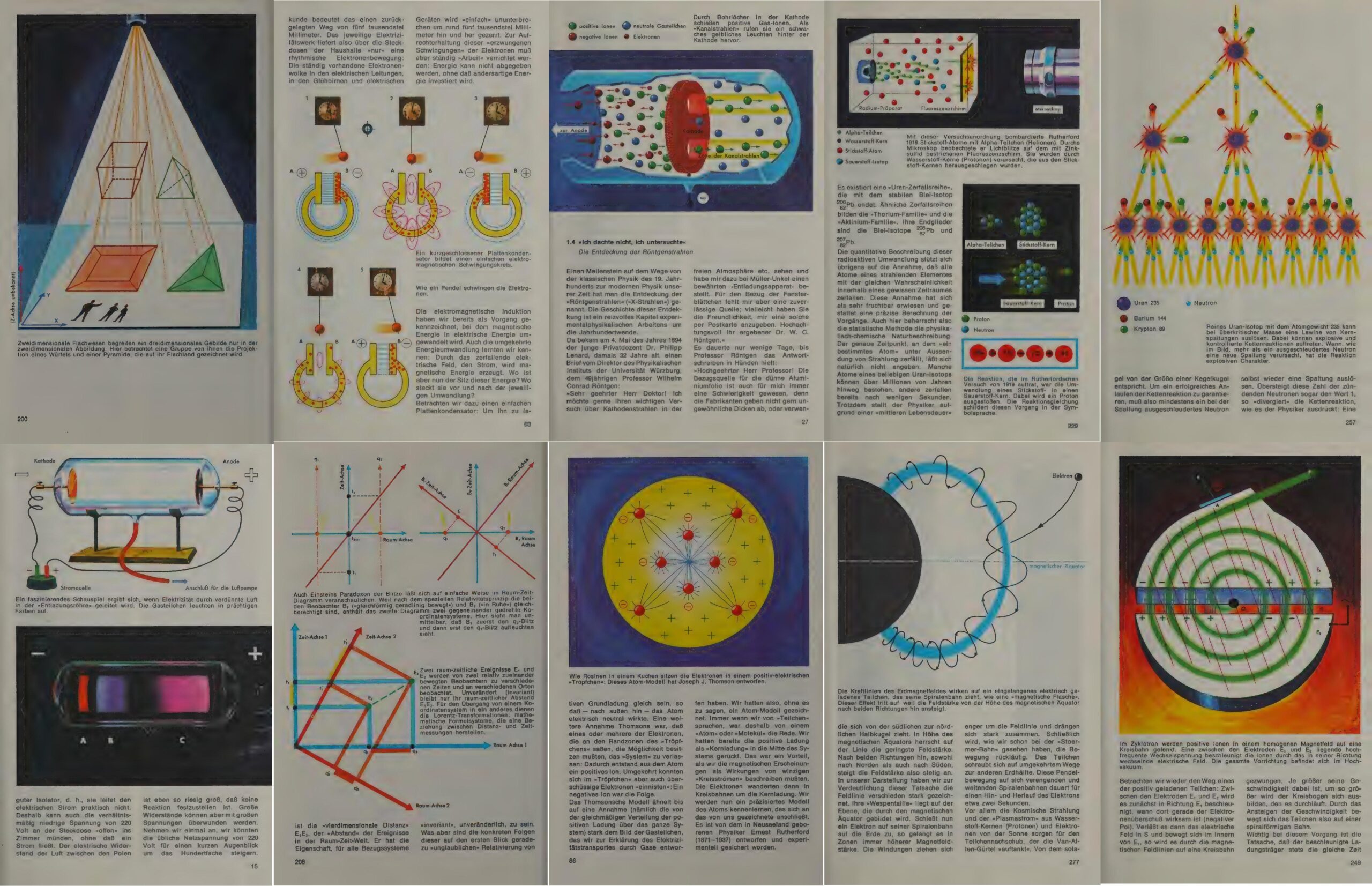
The fact that mathematicians do not value experiments much is a bit strange because historically, many theorems were discovered and distilled from experiments. Maybe it is a nomenclature thing because examples play an important role. If you explore groups for example, you experiment with many different species. Your laboratory is the set of all groups and you try to classify, extract properties and interesting examples. Like a chemist you might want to look for a group that is important in a particular application like physics. Similarly as in biology where one has build taxonomies for classifying life, one can do that with groups. The destain of mathematicians to experiments is in particularly strange: in most sciences, the design and measurement is the main purpose of the field. Finding a new species or a planet with some properties or some rock constellation on Mars, or some new material, are big things. In math, the discovery of some patterns is not so much appreciated The focus had been (until recently at least) in proofs. Maybe this is going to change a bit, given that proofs have become cheap. Its like with diamonds. Until recently they were rare and valuable. The industrial generation of diamonds made them cheaper. Physically and optically, they are identical to real diamonds. Only specialized labs can distinguish them. As for proofs, we still can spot very well whether a proof has been machine generated. It has become already hard to quantify but one just can feel if something is not genuine and has been generated with the help of machines.
