
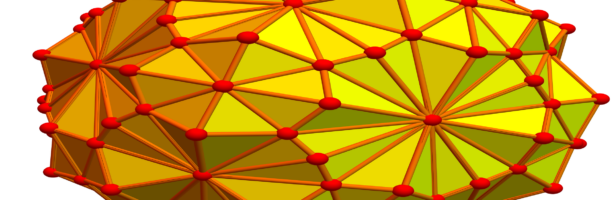
A good discrete differential geometry should mirror the continuum as closely as possible. Positive curvature manifolds should be bounded, the list of positive curvature manifolds should be identical to the ones we know in the continuum. Last year we had looked at geodesic patches and defined sectional curvature by defining geodesic two dimensional sheets through a maximal simplex x, in which a triangle y is selected. The pair (x,y) can be seen as an element in the discrete Grassmannian 

Last year we encountered a fundamental problem with the construct by gluing together local geodesic patches. We encountered manifolds with positive curvature which can be arbitrary large. We even construct non-compact manifolds of positive curvature. That shows that the notion of positive curvature needs to be refined. It is related to the fact that for k larger than 1, geodesics are not necessarily contained in the geodesic manifold. One of the issues is that the geodesic map T reverses orientation. Take k=2 and look at a closed loop in the geodesic patch of odd length. Then going around once that closed loop can not be done by following geodesics. In the frame bundle we have to go around twice. If we do that then the local curvature decreases.
At the moment I think it is best to solve this parity problem by looking at all geodesics of length 2 emanating from (x,y), then take the union of these spiders. This assures that all geodesics are included. But this requires us to show that the manifolds close up.
