
Causality Principle
One of the most exciting principles in physics is the Huygens principle relating the geodesic motion with the wave dynamics. If we are in a Riemannian manifold, there are two type of “wave fronts”. We can look at the solution of the wave equation 


If space is discrete and if we insist on finite propagation speed of waves, we need time to be discrete too.
A) Deform the operator so that the unitary is polynomial
A) This motivates to look at discrete time evolutions, where the “causality principle” works. During grad school, I got interested in the dynamics of the Koopman unitary operators 


[A bit of IT history: At Caltech, I had made the experiments of course with mathematica. I remember that at UT, the IT infrastructure still allowed everybody to use anybody else’s machine for computing. UT already so a large linux cluster available. Until about 2000, worldwide, any unix computer user could talk to any other unix computer user with “talk” or even login to their machines. Places like CERN were still early in late 1980ies completely open. We would just telnet into their servers. News would be obtained from newsgroups. You could even telnet into any printer. Even in the first few years at Harvard, I ran a webserver from my own personal machine, had webcams directly on, or a (self written) CGI mathematica interface open to the web. This all disappeared of course. For may years, we ran specialized intrusion prevention software like fail2ban and I also personally maintained lists of IP address ranges to ban. Things have of course gotten out of control completely and my office machine would get thousands of break in attempts per hour. Now things are protected by firewalls, TPC wrappers and VPN software. It is always a matter of scale. In the 1980ies, very few had access to computers and since these were mostly educational users. When the web came in 1993, things started to change. Things were still pretty open until 10 years later, when broadband internet access started to become available. The internet had been wonderful especially with the appearance of google in the 1990ies. I still remember the day, Hans Koch at UT told me about google (when it was not yet officially launched and you had to know about it). Google had been great. You put something on your webserver and a few days later, you could find it by search. I would put something like xquantum on a course website, and would be found. Today, it is almost impossible to find things on google any more. The latest hit is AI taking over the search. And then thee is greed or profit. You can not find any picture any more of anything except for “picture agency licenced stuff”. ]
B) Deform the algebra to a non-commutative one
B) As for discrete time evolution, there is also the discretization of differential equation as difference equations. An approach, I have used in Math 1a (see the last time I ran it here in 2024). I ran this first in 2011 (see the website from Math 1a). In 2013, the department was running a Pecha-Kucha event. My contribution is here. All the talks can be seen here. What I liked about the discretisation by going into a non-abelian crossed product algebra generated by 1 and translation 

![1, [x]=x \sigma^*](https://s0.wp.com/latex.php?latex=1%2C+%5Bx%5D%3Dx+%5Csigma%5E%2A&bg=ffffff&fg=000000&s=0 "1, [x]=x \sigma^*")
![[x]^2=x(x-1), [x]^3=x(x-1)(x-2)](https://s0.wp.com/latex.php?latex=%5Bx%5D%5E2%3Dx%28x-1%29%2C+%5Bx%5D%5E3%3Dx%28x-1%29%28x-2%29&bg=ffffff&fg=000000&s=0 "[x]^2=x(x-1), [x]^3=x(x-1)(x-2)")
![Df(x)=f(x+1)-f(x)=[\sigma,f]](https://s0.wp.com/latex.php?latex=Df%28x%29%3Df%28x%2B1%29-f%28x%29%3D%5B%5Csigma%2Cf%5D&bg=ffffff&fg=000000&s=0 "Df(x)=f(x+1)-f(x)=[\sigma,f]")
![D [x]^n = n [x]^{(n-1)}](https://s0.wp.com/latex.php?latex=D+%5Bx%5D%5En+%3D+n+%5Bx%5D%5E%7B%28n-1%29%7D&bg=ffffff&fg=000000&s=0 "D [x]^n = n [x]^{(n-1)}")
u(t) = cos(D t) u(0) + t sinc(D t) u'(0)
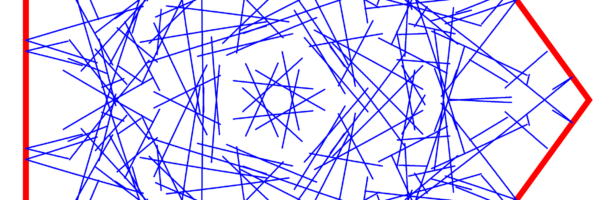
then this makes perfect sense in the finite discrete proto calculus and is an exact solution! It is just that the cosines and sines and sincs are slightly deformed. We have now a difference equation. But if time is scaled such that the Planck scale is 1, then this does not matter in any experiment. You can run a very high energy x-ray from the end of the universe and the amplitude would not change significantly if it reaches earth. You can experiment with deformed polygons using the mathematica notebooks provided on the Pecha Kucha page of 2013. See the footnote (*).
C) Use non-commutative Quantum mechanics
C) If we use non-commutative evolution, we solve various problems together. Rather than evolving a wave using the wave equation 

A geometry can always move within its group of symmetries.
In general, this has no effect. If a triangle moves in the Euclidean group its properties like angles or area do not change. If a geometry with an exterior derivative moves in its symmetry group however, then it naturally develops an expansion that has an inflationary start and moves part of its Dirac matrix into a part which is not “visible” if the waves (and so distances) are computed with the exterior derivative that produces the Maxwell equations and cohomology and all geometry. The key is the Connes distance formula which allows for a reformulation of Riemannian distance using the derivative. While the observation of Connes is totally obvious, it allowed him to move also Riemannian geometry into non-commutative settings. See the QR article for more.
(**) I told the story in my “golden rotations talk”: Froehlich was testing us all orally and structured the exams as “Pflicht und Kuer”, where we could talk freely about one of the topics (Kuer) and were asked some questions without choice (Pflicht). I talked in my Kuehr about the motion of a free top in n-dimensional space (which can be found in Arnold’s book). It is a nice picture: the motion is a geodesic flow on the rotation group SO(n). The lie algebras so(n) is the tangent space so that the flow talkes place on the unit tangent bundle within the tangent bundle T SO(n). Froehlich drew in the Pflicht a picture of the Eiffel tower on the board (he just came back from the IHES to ETH as he missed teaching at IHES) and drew a top on top of it and asked “How does it move”. Before leaving, he told me: “Herr Knill, d’ Bourbaki Ziite sind vorbii” (the Bourbaki times are over). I think that he had been wrong in that one , as we have seen its revival: in very abstract mathematics with rather brave structures like Grothendieck universes. But Froehlich helped me to stay mathematically on the ground later during my studies.
(*) On pedagogical note, I must say that my course Math 1a had been a success even so, I covered much more material than what other courses do: there were components about AI (already in 2011), statistics, music, computer science, economics, advanced integration techniques like trig substitution, partial fractions and the vast majority of students had never seen calculus before. I do not teach this any more, so I can tell the secrete of the success. But it is better to tell how you can ruin a calculus course (and many calculus courses today do follow this):
- 1) Pollute with units. There is almost an obsession of math educators to insist on always work with units. One can of course argue about it because in most sciences it matters. But we are in math and should be able to focus on the essential mathematical ideas. Its like filling a poem with legal footprints. It adds an other layer of difficulty and I must say that many of the problems I had to solve which I find in handouts or books are just hard to parse.
- 2) Use parameters. You could use D f(x) = (f(x+h)-f(x))/h and do everything with that additional parameter h. But who cares. it is just the choice of scale. Why not use units where h=1? Much of physics can be written more elegantly without units. As I mathematician, I write the Maxwell equations as dF=0,d*F=j, the Einstein equations as R-Sg/2+Lg=T . If I would have to compute stuff quantitatively, then of course, units will have to be used to match experiments.
- 3) Include data science. I vented about this elsewhere. Data are important of course, but insisting that students have to fill in large spreadsheets with data belongs to other classes. We are poets, not accountants. And the spreadsheet paradigm has long been known to be one of the worst disasters which ever could happen to science. Since data and code are not separated, spreadsheets can hardly be audited and are so full of errors in general. (I vented about this since 2004). 90 percent of corporate spreadsheets have material errors in them.
- 4) Long winded problems. Just look at the size of a typical algebra or calculus textbook. Who reads 2000 page textbooks?
- 5) Bad notation. This is difficult. One has to be simple but not too simple (***) I do not want to elaborate but this has a historical background. Newton’s notation was horrible, Leibniz notation was gold. By the way, Leibniz already used discrete settings to illustrate his mathematics. (***) a footnote to a footnote: in our family there was the running joke: “Come home when ever you like. But not later!”
