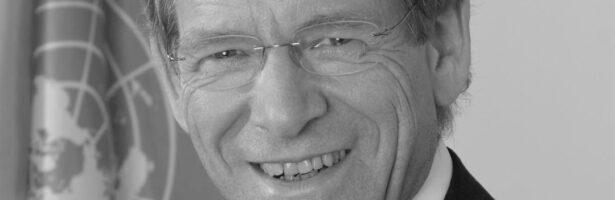
I only learned recently thought the “not even wrong” blog that Konrad Osterwalder passed away last December. He had been department head at ETHZ from 1986-1990 which overlapped quite a bit with my graduate student time there. He then became rector of ETHZ and became later an important figure in the united nations but he had some graduate students that were also assistants but I could only admire and not appreciate the difficulty of the problems they were working on. I never took a course taught by Osterwalder (some of my non-math friends did as Osterwalder taught large linear algebra courses for chemists or engineers) but I took quantum mechanics from his advisor Klaus Hepp and a quite advanced mechanics course from Juerg Froehlich, an other student of Hepp. Res Jost (whom I never met) had been an other advisor of Osterwalder and I took electromagnetism from Jost’s student Walter Hunziker, a symplectic geometry graduate course from the Jost student Eduard Zehnder (who also passed away recently) and a postgraduate course about dynamical zeta function by an other Jost student: David Ruelle.
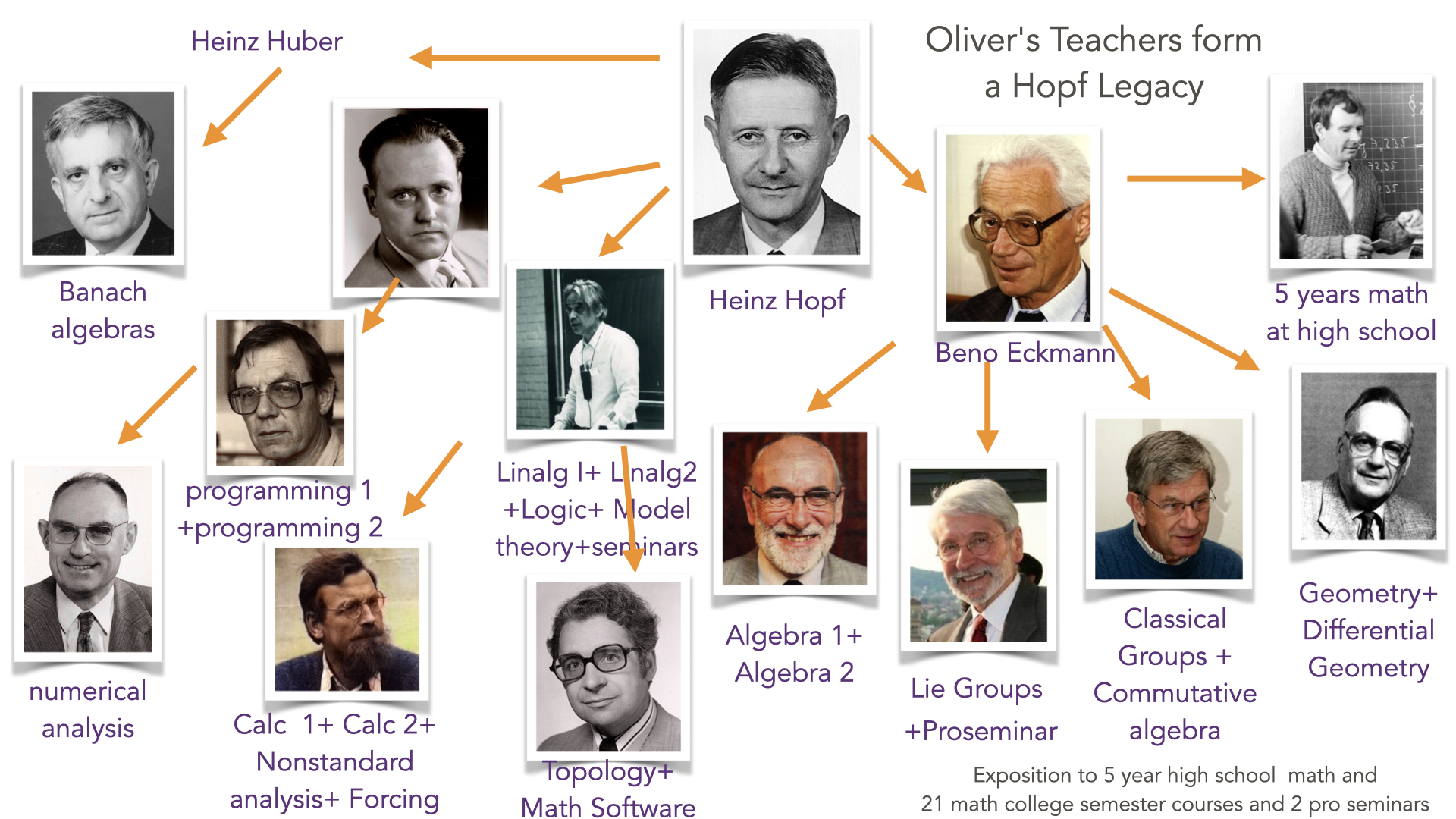
Today, it is kind of funny to see how small the academic world was even a few decades ago. Osterwalder belonged to the “Jost” branch. The majority of my teachers were academic descendents of Heinz Hopf (slide) and even my high school teacher belonged to this group. Osterwalder was pivotal in the transformation of the “old ETHZ ” through the Bologna process to make it more compatible with the other European universities and so more international. I myself had a great college experience, had a fantastic choice of courses, was forced to learn a wide spectrum of mathematics. The teachers were all top notch, the administrative overhead was minimal. The Bologna process naturally introduced more layers of complexity like a now almost mandatory masters program. I can only imagine how much work must have been necessary to go through such a reorganization. Obviously, all this administrative work, did not leave much time for Osterwalder to do much research, as it seems.
Already then, while I was in graduate school, it appeared (maybe it was less obvious yet) that axiomatic quantum field theory is more difficult than anticipated. This mathematical axiomatic approach was spear headed by Arthur Wightman (my academic grand father …) but my academic father Oscar Lanford had moved on from that subject to greener pastures like dynamical system theory and statistical mechanics. Also other students of Wightman like Jerold Marsden or Barry Simon worked initially in that field but branched off to other topics in applied mathematics or mathematical physics.
Osterwalder might not know this but he was quite important to me like becoming a course assistant and later graduate student. Quite early on as a graduate student, I was asked by Osterwalder to look into chapter 12 of the book of Cycon-Froese-Kirsch and Simon to assist in a seminar on Patodi’s proof of the Gauss-Bonnet-Chern theorem. I spent a week alone on the alp “Salmenfee” in the Swiss mountains during a summer break, working through that chapter. The seminar eventually did not take place; the exposure to that book however turned out to be life changing for me, as the book contained a nice concise introduction into modern Riemannian geometry. Having seen in college only a basic undergraduate differential geometry course, by Max Jeger, focusing on curves and surfaces, this widened my horizon. The book also contains a chapter on almost periodic Schroedinger operators, a topic that is closely related to ergodic theory, and a relatively fresh area of mathematics. The topic had been popularized especially in the form of the Hofstadter butterfly which I had read in high school. The concept of Lyapunov exponents of transfer matrices touches upon chaos theory, something which appeared in my senior thesis at ETHZ. So, I’m sure that without that “nudge” to look into that book, my thesis would have have taken different turns.
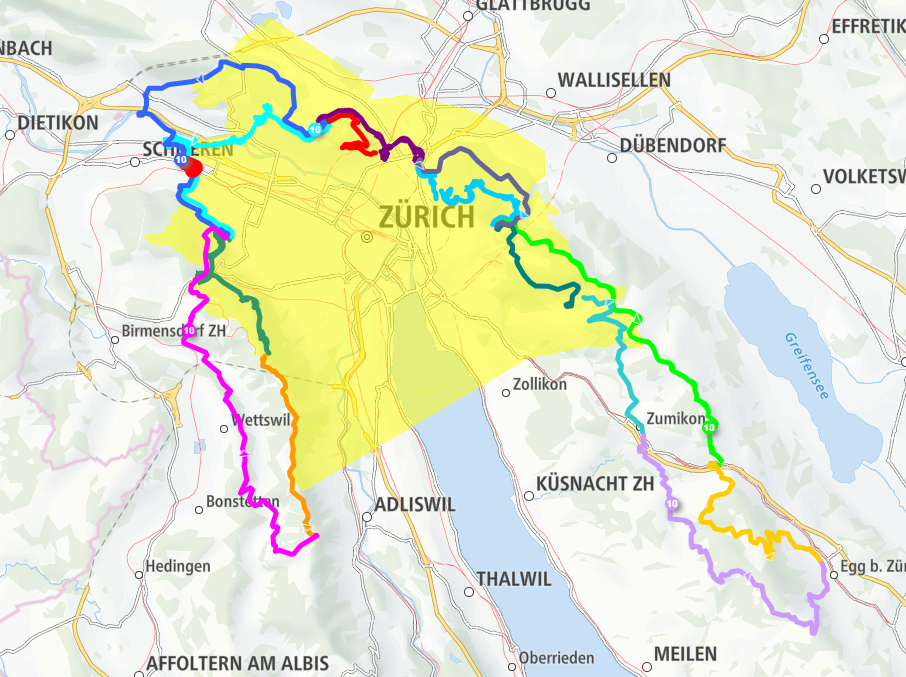
An other encounter happened at the SOLA Staffette, a traditional run over 115 km where a team of 14 run 14 sections around Zuerich. It is the largest university sports event in Switzerland and I just saw that it still takes place in a similar manner today. I remember that I had to run somewhere near Forch or Zumikon and that I passed the stick to Konrad Osterwalder who was also in the “Mathematicians Team”. This must have been around 1989-1990. I’m not sure whether the route was the same then as it is now, but what I see on this page looks about right. Osterwalder was then close to 50 years old, but physically in great shape (I think most of the team was mostly of younger graduate students).
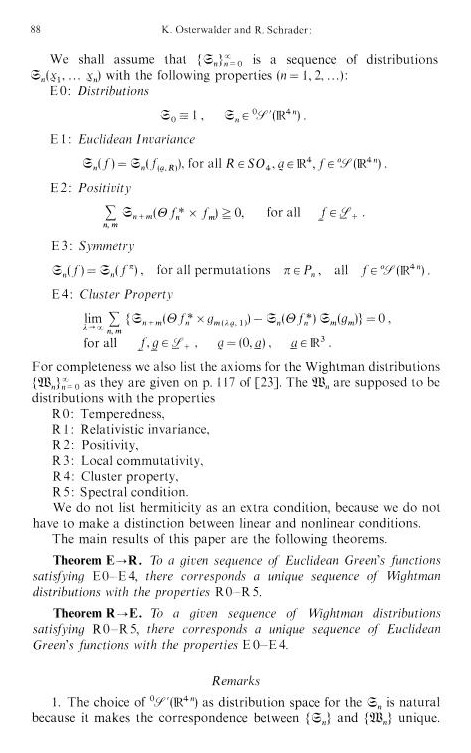
In mathematics, Osterwalder is most obviously linked with the Osterwalder-Schrader axioms from 1972, while he was a postdoc at Harvard. It is an axiom system for Wightman distributions. The choice of distributions is kind of interesting philosophically and is a case where the difference between “geometries” and “fields” is huge. Distributions are the dual of smooth functions. There is an other interesting point in that Euclidean quantum field theory can be analytically continued into a Lorentzian case. The point of the approach was to work with Euclidean Schwinger (*) functions and then show that this can be carried over to a Minkowski quantum field theory by a rotation in the complex time plane. It appears however that for realistic 4 dimensional field theories, one just has no interesting example. This triviality conundrum is what I understand to be part of the mass gap problem which Chatterjie talked about last October. I don’t know much about this part of mathematical physics but it seems that the problem is just too difficult and that different approaches are needed.
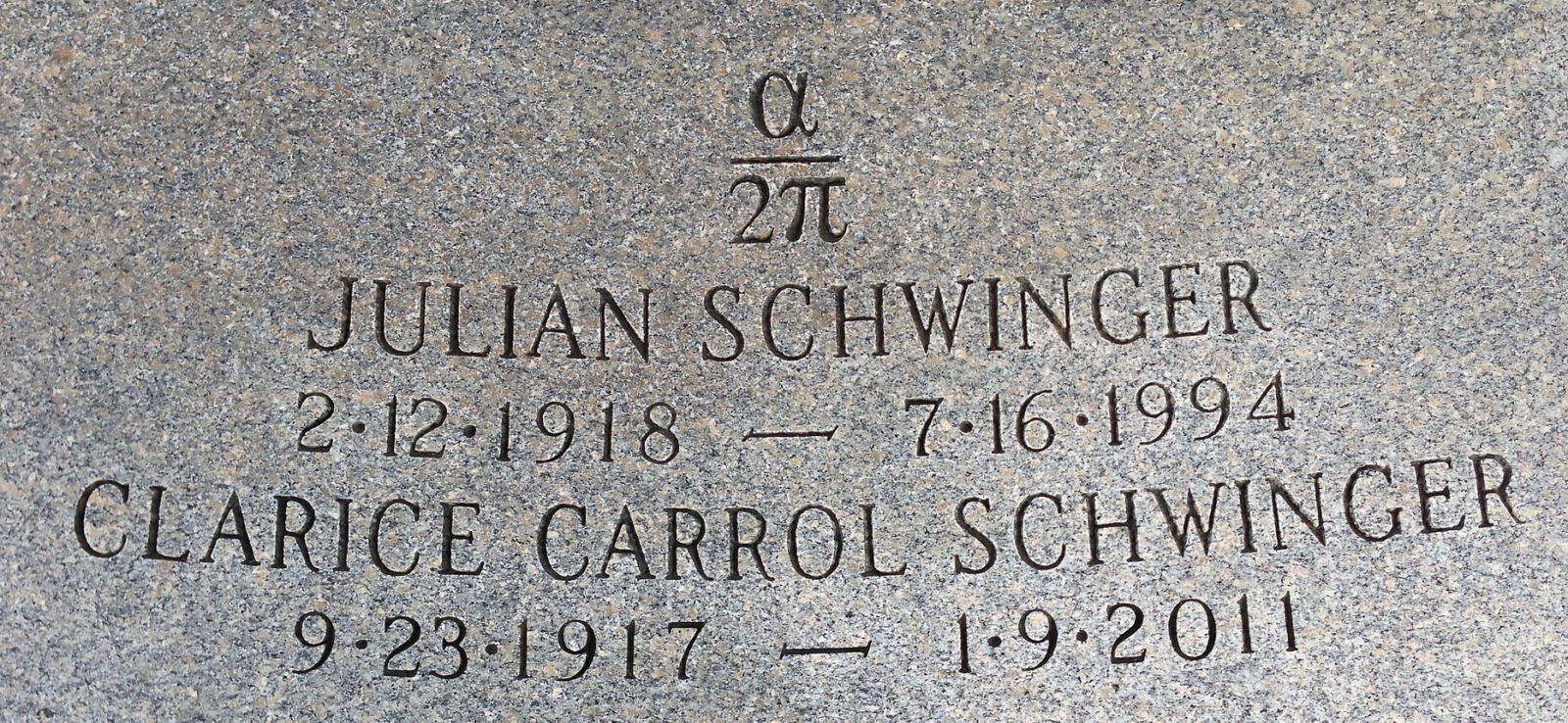
(*) About Schwinger: his grave is at Mt Auburn. About 10-15 years ago, I once decided to extend a run in that neighborhood and visit the grave of Schwinger. A park ranger confronted me near the Schwinger grave and claimed that running is not allowed. I counter claimed that this is not true and that there is no rule telling that one can not run and continued to jog. A chase followed through the cementary, as the guard alerted others and they attempted to catch me with a car. They cornered me at the exit. And indeed they showed me the park rules states that running is not allowed at Mt Auburn. (This is different in other cementaries in the region like Arlington, Winchester or Medford, which I regularly cross). I looked up discussions about this and the opinions and attitudes are wide One can see for example that during the Victorian period (200-100 years ago) cementaries were frequently visited by families for leisure and treated like a park. Families would have picknicks there and visit their dead relatives. There are places, where one runs even races, like the “Run like Hell 5K”. One can argue about this. One can also argue, whether it makes sense to allow to drive with a stinky SUV through a cementary and in the same time forbid a quiet, exhaust free run. But of course, rules are rules. What should happen however (and this is not the case in Mt Auburn) that the rules should be visible at every entrance. The customs are different in different places and also internationally. In Switzerland it is by law not forbidden to run in public cementaries and it seems also that in most of the cementaries in the US, running is generally permitted. There are of course many opinions about this. In my opinion, death is part of life and cementaries help to remember past lives. Visiting such places helps us also to be reminded that we are all mortal. I do not think that Schwinger would mind having from time to time somebody running past his stone and remembering him. Schwinger taught at Harvard from 1945 to 1974. He was the Eugene Higgins professor at Harvard. One of his students was Roy Glauber (who lived in Arlington MA). When I pass route 60 in Arlington, I always remember him because there is a funny story about him: Glauber got the Nobel prize, but a burgler once broke into his house stole it. It is amazing how many students Schwinger had, especially at Harvard.
[Update February 26, 2026:] Schwinger, Jost and Wightman probably are closest in the context of the CPT theorem. I find quantum field theory too difficult but this is one of the things which I could appreciate as a student as it is an elegant relation between three “involutions” in physics: charge inversion, parity inversion and time reversal. It is a remarkable theorem as still today no violation has been found. It in particular illustrates that time is reversible in principle. Physical processes are all time reversible. Statements like “entropy increases” are lies or hold in set-ups where information is lost due to natural limitations of keeping track. The CPT theorem was proven in 1958 by Res Jost. The history of the theorem is interesting: it appeared in 1951 in the work of Schwinger already, Pauli and Bell also gave proofs before Jost gave a general proof in 1958 in an axiomatic setting. It also relates to the Feynman Stueckelberg interpretation that anti matter is matter moving backwards in time. I wrote once in 2022 a blog entry about Stueckelberg. It is an interesting Swiss figure, who taught in Lausanne from 1930-1970 and comes with interesting pop-culture stories like the origin of the phrase “not even wrong” or my own explanation why he was not cmore famous: who can remember the full name “Johann Melchior Ernst Karl Gerlach Stückelberg von Breidenbach zu Breidenstein und Melsbach“? (By the way, I tried to get some CPT symmetry into the Toda differential equations as a student (see page 134 or 153 of my thesis.) It is also related to a later favorite of mine, like “coxeterizing” geometry and arithmetic: do sonsider involutions to be the fundmental building blocks. Any translation for example can be written as a product of two point involutions. A rotation can be seen as a product of reflections at subspaces. Max Jeger, my geometry teacher teaching geometry to us first year students, liked “spiegelungs geometrie”. I wrote about this more in “graphs, groups and geometry” where one of the upshots was that the dihedral group <a,b| a^2=b^2=0> is more natural than the integers : the former is natural in the sense that there is a metric space which has a group structure such that all translations and inversions are isometries. The integers with the standard topology does not have this property as it carries both the group of integers as well as the dihedral group.
I only very briefly met Osterwalder here at Harvard, once when he had been discussing with Arthur Jaffe in the LISE coffee shop and Jaffe told that they plan to write a new paper. That was maybe 10 years ago.