The Herman dial circles in the space of bounded measurable matrix cocycles over a dynamical system produces circles on this space. Herman showed that the average Lyapunov exponent over this circle is larger or equal than the Herman number . More generally, we can take a partition of into sets of size and look at the plurisubharmonic function with where we turn on by an amount of . Herman’s computation on the right hand side of the board now shows that $lambda A(0,\dots,0) = H(A)$ is the Herman number of the cocycle. It would be nice if we could use special partitions and such multi Herman dials to get a grip on more concrete problems. The multi-dimensional case also indicates that we should be able to do the deformations in a continuous way , but that requires that we do not use additionally other perturbation.
In my paper on page 326-327 is an explicit deformation of the cocycle given, where the partition is a Rohlin tower. The advantage of Rohlin towers is that the return time to the base is bounded and no dominated convergence theorem is needed. What was done then was to induce on Z, turn there to to get positive $\lambda$, use the Ledrapier manifold (Oseledec stable space) to in crease by a definite value larger than so that is positive on a set which is dense. This allows to reverse the rotation and a small wiggle to get positive . This is unfortunately not uniform. We would like to have a property of the cocycle which would give us deformations in which the lower bound stays, as tried last time. That can not work in general as the coboundaries show which can have but have . Interesting to study would be the infimum of all over all .
So, I for now have to take back the claim done in my morning talk that the deformation can be done with rotations only (at least for now). I still need the diagonal push. During my presentation this morning thought that I can get away without the diagonal push on the Ledrapier manifold, the stable Oseledec manifold. When using the Diagonal push help, we have to approximate the diagonal push which is only measurable in by continuous diagonal pushs. I therefore also have to take the statement back that the argument can be extended easily to the continuous category. That seems possible if we need only rotations.
What seems to work nicely is the extension to real symplectic valued cocycles. In the real symplectic case we still have , where is upper triangular with entries in the diagonal and in the supper diagonal part. But this means is non-negative and still zero if and only if A=I. I have also to take back the claim that we can do the Herman deformation in the SL(2,C) case by just copying the real case.The computation of Herman (given also on the board) works in the complex case using the QR decomposition , where is in and the functions and in the upper triangular part are now complex. The Herman number still is but unlike in the real case where and means and so , this is is no more the case in the complex. We can find SL(2,C) cocycles where H(A)=-infinity which is the case if ib=a+1/a. This looks like a technical issue only as we use specific Herman dials. We can do rotations along any unit quaternion.
There is a rescue however which makes the SL(2,C) case work: as can be written as a subgroup of the real symplectic group . The rotation is now a rotation in rotating two dimensional planes around each other. Now the is non-negative and is zero if and only if the symplecic matrix is . If we wanted to work with Sl(3,C), we would have to use matrices of the form with and then see this as a real symplectic matrix in dimension 12. The deformation however is now done within this symplectic group and not within Sl(3,C) itself. In any case, these seem just to be technical side battles. The real focus should be on the case and whether a subharmonic or pluri subharmonic approach using rotations alone can do the perturabation to positive exponents and under which conditions one can actually say something about the the cocycle A itself.
Update of October 25: while running today, I thought a bit more about the case of symplectic Sp(2m,R) cocycles, which really is the natural higher dimensional analog as we want the positive and negative Lyapunov exponents to match. The density result for the maximal Lyapunov exponent follows almost verbatim the Herman approach I used in my 1989 paper. We so have for almost every point a 2 dimensional plane spanned by the Oseledec spaces for the largest and smallet exponent. This allows to build a new symplectic structure so that the cocycle can be restricted to the orthogonal complement. The situation is now reduced to 2 dimensions lower and we can apply the density result again. So, for symplectic matrices, we have a dense set with a complete Oseledec splitting. And this all just uses the magic of Herman’s 1983 paper.
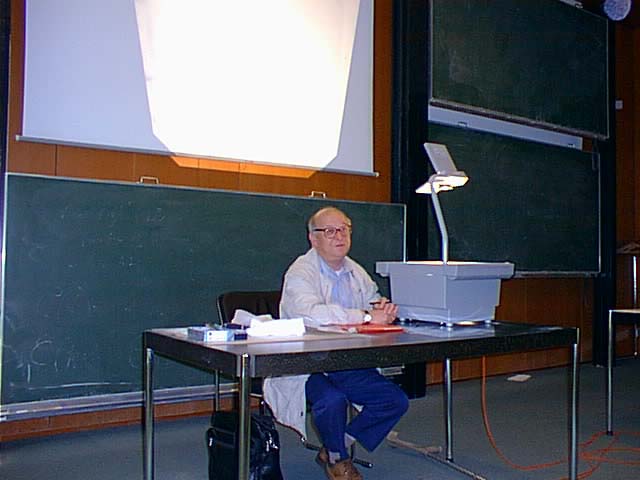
To the right is a picture of Michael Herman. I had it in my harddrive but do not remember who took it. But I have seen talks of Herman and he would indeed like to write by hand on an overhead projector. I could not find any video of him and I’m sorry I lost notes about the talks he gave. I must say that I had a bit of difficulty to read the handwriting on the projector and also had assumed that this would appear in print soon. I was at Caltech already getting more into other topics.
Hermann already states at the very end of the 1983 article “Une methode pur minorer les exposants de Lyapunov” the case of the Lie group Sl(n,C) but just states that the average of over |z|=r is bounded below by , if a is an element of the lie algebra. He used the Herman dial on SL(2,C) already but did not give a lower bound in terms of the entries a(x),b(x).