
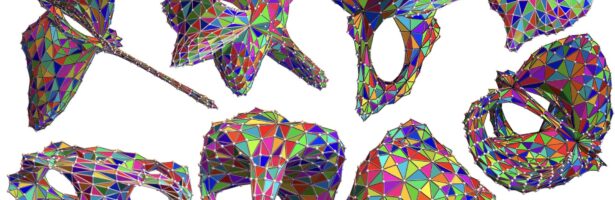
If one adapts the picture that particles are not points but circles, then the world lines of particles become world sheets. The topology of this sheet describes the interaction. A torus for example could describe the emergence of a particle, which then splits into two particles, merges again to one particle then disappears. Given a 4-manifold, what is the genus of a typical surface? These are not well defined questions in the continuum, unless one decides what probability measure of surfaces one takes. Already in the case of random curves, like Brownian motion, it is not obvious how to define the Wiener measure on the set of all continuous paths and this only dealt with the problem of a single particle which is not allowed to split, merge or form loops. My level set theorem naturally leads to probability spaces of co-dimension k manifolds in q manifolds. We can therefore look at the statistical problem. Ioriiginally suggested that to Jennifer Gao in 2023 as a senior thesis project but Jennifer then wrote a beautiful thesis discussing more topological aspects of graphs.
Here is a simple case. Lets take a 2-manifold G and ask the question what is the expected number of points of a random codimension 2 surface (a collection of finite points). We have already a probability space of 

Let me look here at the simplest possible problem of this type. Take a 1 connected 1 manifold (it must be 

