Euler characteristic super sums energy of space. It subtracts the number of odd dimensional parts from the number of even dimensional parts. It can not be defined for an arbitrary metric space in general. Bouquets of spheres like the Hawaiian rings (am infinite union of circles) or the set 
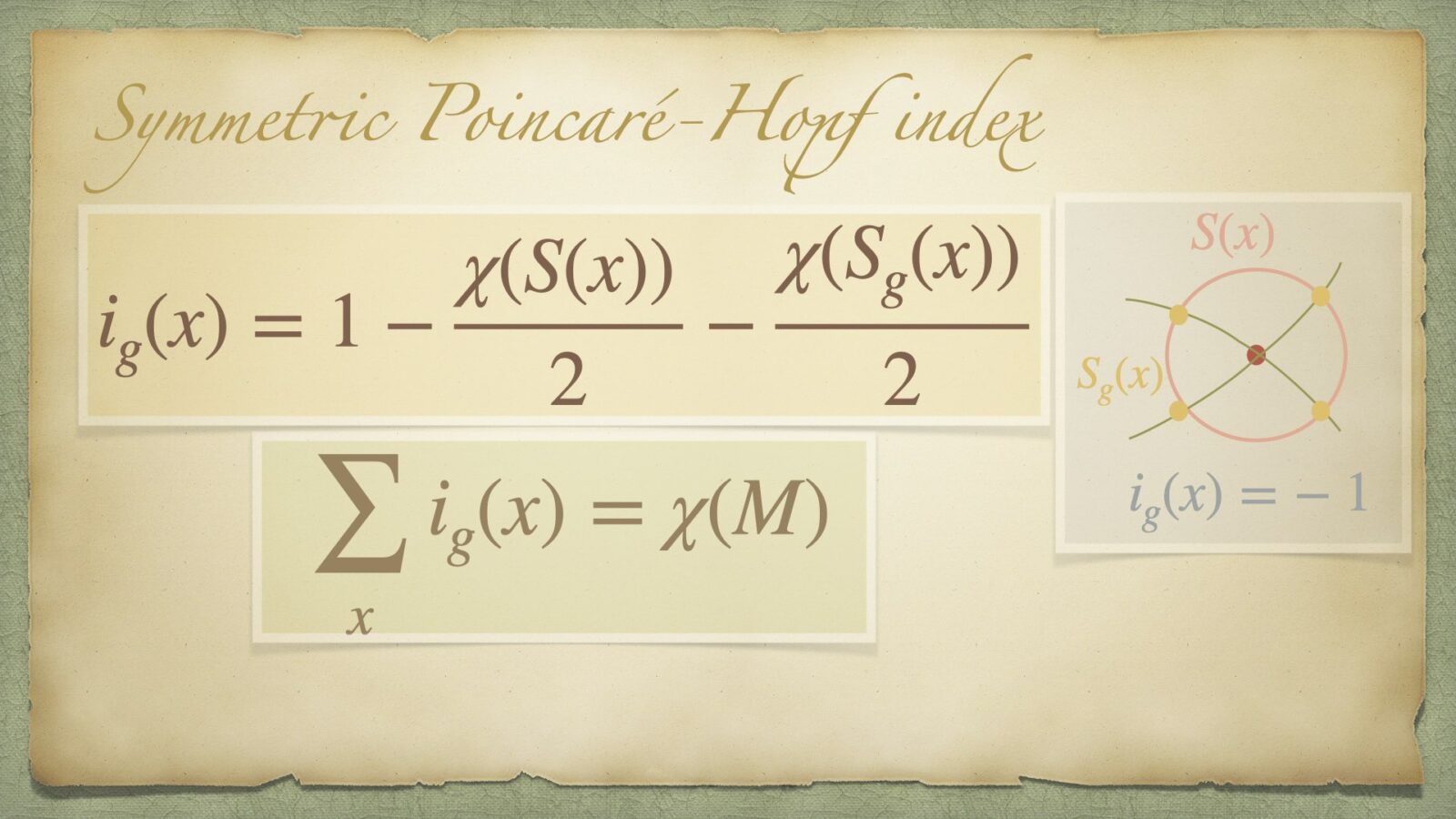
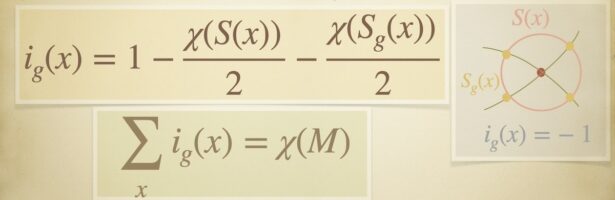
Both in the case of C^1 manifolds as well as finite simplicial complexes, one can compute Euler characteristic in three different ways: in an algebraic way using kernels of Laplacians, in a combinatorial way by super summing simplicial elements in space, or in an analytic way by adding up indices of a function. For topological manifolds there are limitations in general. The combinatorial path through triangulations is out because not all topological manifolds can be triangulated.There are ways out however as we can build a CW structure or then build a homotopic equivalent thickened manifold with boundary on which a triangulation and so counting is possible. As for the analytic case, the definition of the index is not an issue if one takes the index formula 


In this presentation I muse about using the analytic approach more seriously and defining a class of metric spaces which have the property that at every point a sufficiently small 


I really like the index formula as usually, the index of vector fields refers to a tangent space structure and a notion of topological degree, which we do not have in the discrete. It makes in any situation where we have a notion of unit sphere and a notion of level set. What is nice in the discrete is that both of these notions are very easy there.
There is an other reason, why I started to think a bit more about this topic. I will again teach differential geometry and it would be really nice to teach such a course “radically different” and for example forget about any tensor calculus. Curvature can be defined very nicely as the expectation of Poincare-Hopf indices. The strategy would be to define Euler characteristic inductively with respect to dimension via Poincare-Hopf. Start with zero dimensional spaces for which it is just the cardinality, then one dimensional spaces for which the index formula reduces things to count the number of boundary points: the index at a boundary point is 1/2, the index of any other point is zero. Now we can proceed to two dimensional surfaces, where we just need to count the number of nodes on a small sphere where the function value is the same than the function value at the center. This produces index 1 at maxima and minima and index -1 at saddle points and index -2 at a monkey saddle etc. The curvature expectation on the boundary agrees with the geodesic curvature, tin the interior with Gaussian curvature and we would have a simple proof of the Gauss-Bonnet theorem in two dimensions. But it does not stop here. For an interior point of an odd dimensional manifold for example, the curvature is zero because every index is zero: