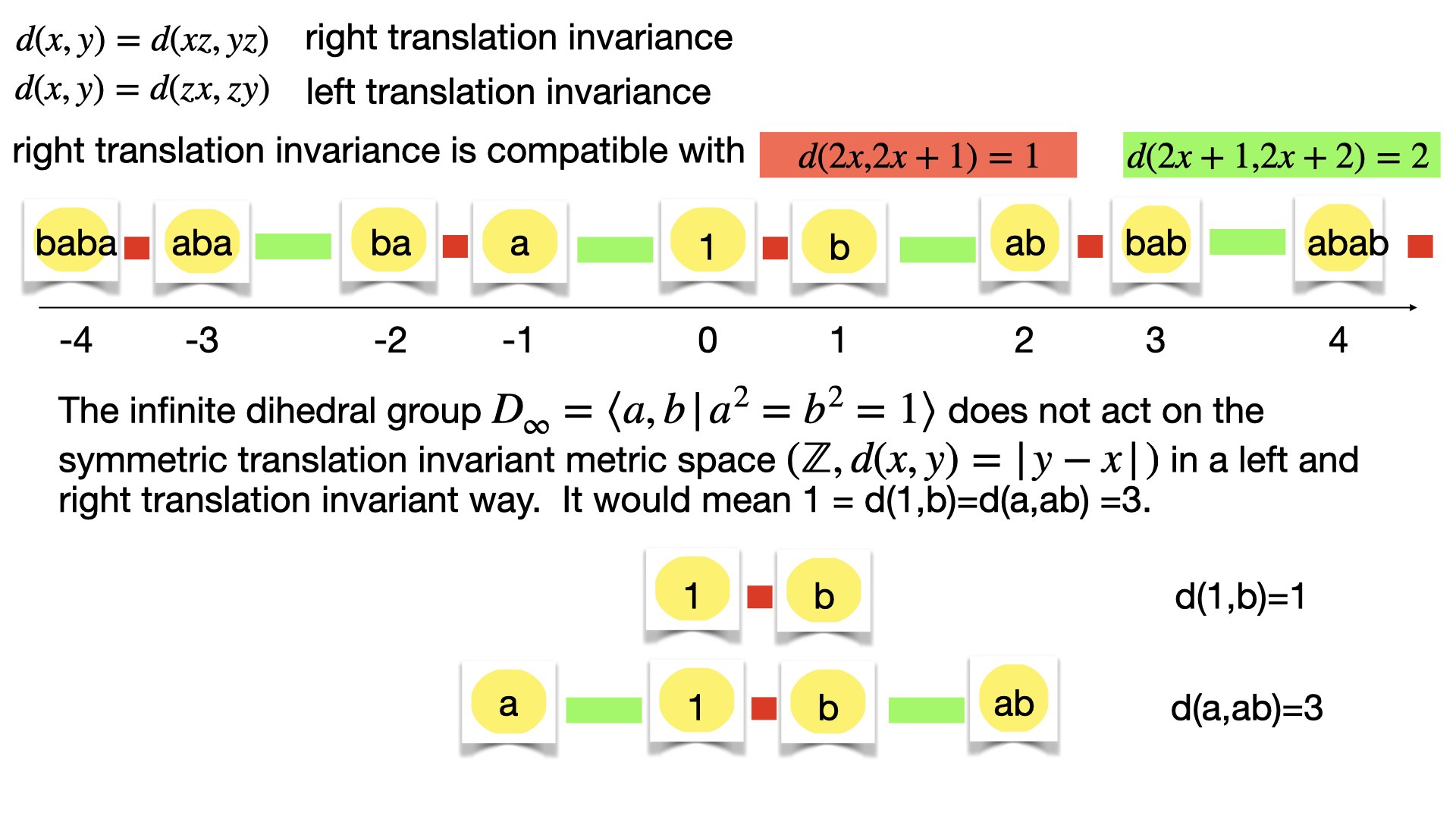
Jakub Gismatullin informed me about an issue with the definition of natural groups, I gave here in 2022. It is easy to fix in that we only need one sided invariance assumption (something I seem to have assumed throughout the paper). In the definition however, I assumed that bi-invariance and the inverse operation is an isometry [It turns out that inverse operation to be an isometry follows from bi-invariance). Jakub Gismatullin calls the metric spaces or groups “strongly natural”, if the bi-invariance assumption is taken. Surprisingly, the results are sometimes quite opposite. The group (Z,+,0) is strongly natural, but not natural. The infinite dihedral group 
The story is an other lesson for me analog to the Lakatos tale about Euler characteristic of polyhedra “Proofs and refutations”. In the early days of topology, folks have used notions of polyhedra that were incompatible with the theorems. The culprit in Lakatos story were imprecise definitions. It happens often in mathematics that definitions evolve. What is a problematic (and I’m guilty of this in the case of natural groups) is to define something in one way and then use a different definition to prove things.
My mistake was to assume that it does not matter whether one uses one sided invariance or two sided invariance. But the infinite dihedral group is an example, where the assumption of two sided invariance forces the distance d(x,x+1) to be constant. This then impliesthat also the additional group structure Z appears. Lets look at the group 

The right invariance assumption implies that d(1,b) = d(a,ba)=d(ab,bab) etc. and d(a,1)=d(ab,b)=d(aba,ba) so that we have no choice for the metric, once the distances d(a,1) and d(1,b) are given. If we take such a metric with different distances, then the translation group Z can not be imposed. The group structure has to be $latx D_{\infty}$ and the group is is natural.
Now lets look at the left translation d(1,b) = d(a,ab)=d(ba,bab) but note that by the triangle inequality d(1,b) must be smaller than d(ba,bab). Not even the symmetric metric d(x,x+1)=1 does work as then d(1,b)=1 and d(ba,bab)=3. The group 
While this is vexing, I personally find this fascinating (and this is discussed quite in detail in my 2022 article): if we take symmetries seriously like Emmy Noether did and see them fundamental, then the group