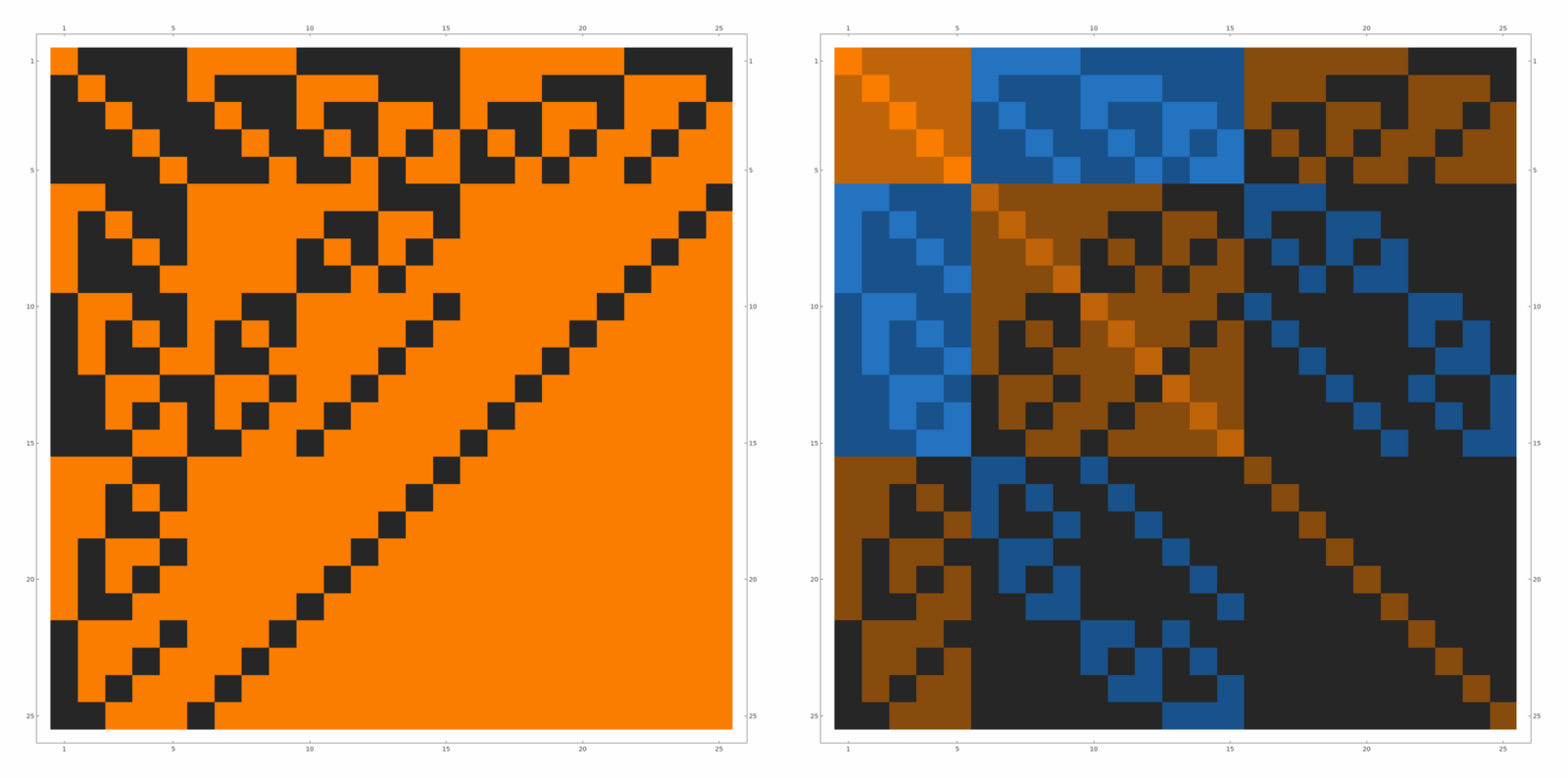
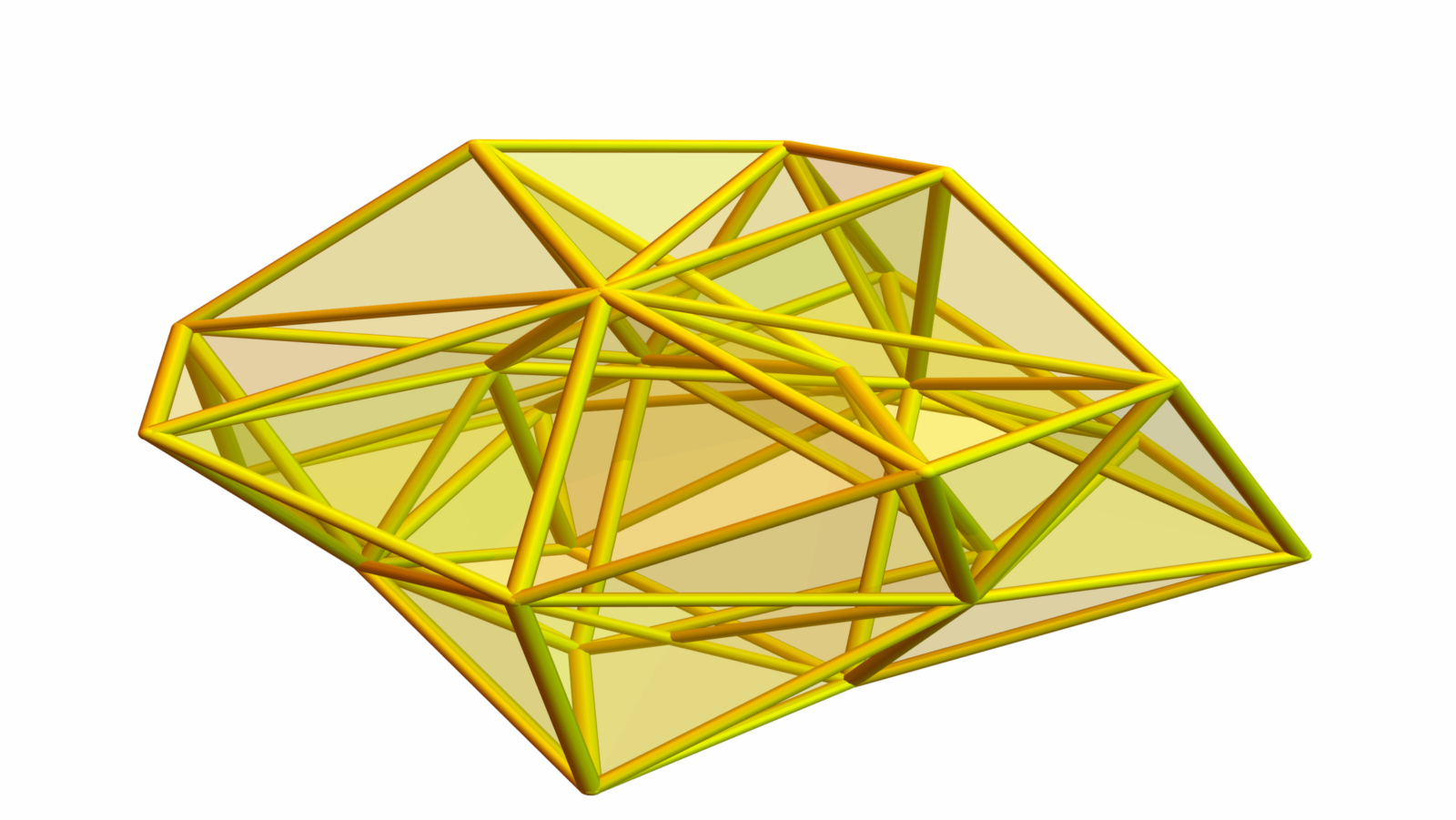
In my article Remarks about Connection and Dirac matrices, I had asked in question C, whether the connection Laplacian always has a larger spectral radius than its inverse g. Robert J. George has found a counter example. The skeleton complex of K5: Here is some Mathematica code showing that example:
Generate[A_]:=If[A=={},A,Delete[Union[Sort[Flatten[Map[Subsets,A],1]]],1]];
Whitney[s_]:=Generate[FindClique[s,Infinity,All]];
Connection[G_]:=Table[If[Length[Intersection[G[[i]],G[[j]]]]>0,1,0],{i,Length[G]},{j,Length[G]}];
G=Select[Whitney[CompleteGraph[5]],Length[#]<=3 &];   (* example by Robert George *)
L=Connection[G]; g=Inverse[L]; N[{Max[Eigenvalues[g]],Max[Eigenvalues[L]]}]
The spectral radius of g is interesting as it measures the spectral gap of L. It is a measure for the stability of the “vaccuum” u=0 in the situation. A Large spectral radius g means that the system has less leverage for being stable. What do I mean with stability? Take the nonlinear discrete PDE 


The following experiment shows that for any even k larger than 1, for large enough n, the k-skeleton complex of K_n has this property.
Generate[A_]:=If[A=={},A,Delete[Union[Sort[Flatten[Map[Subsets,A],1]]],1]];
Whitney[s_]:=Generate[FindClique[s,Infinity,All]];
Connection[G_]:=Table[If[Length[Intersection[G[[i]],G[[j]]]]>0,1,0],{i,Length[G]},{j,Length[G]}];
F[n_,k_]:=Module[{},G=Select[Whitney[CompleteGraph[n]],Length[#]<=k+1 &];
  l=Connection[G]; g=Inverse[l]; Max[Eigenvalues[1.0*g]]-Max[Eigenvalues[1.0*l]]];
Do[Print[F[n,2]],{n,3,10}]
Do[Print[F[n,4]],{n,3,10}]
Do[Print[F[n,6]],{n,3,10}]
The skeleton complex 
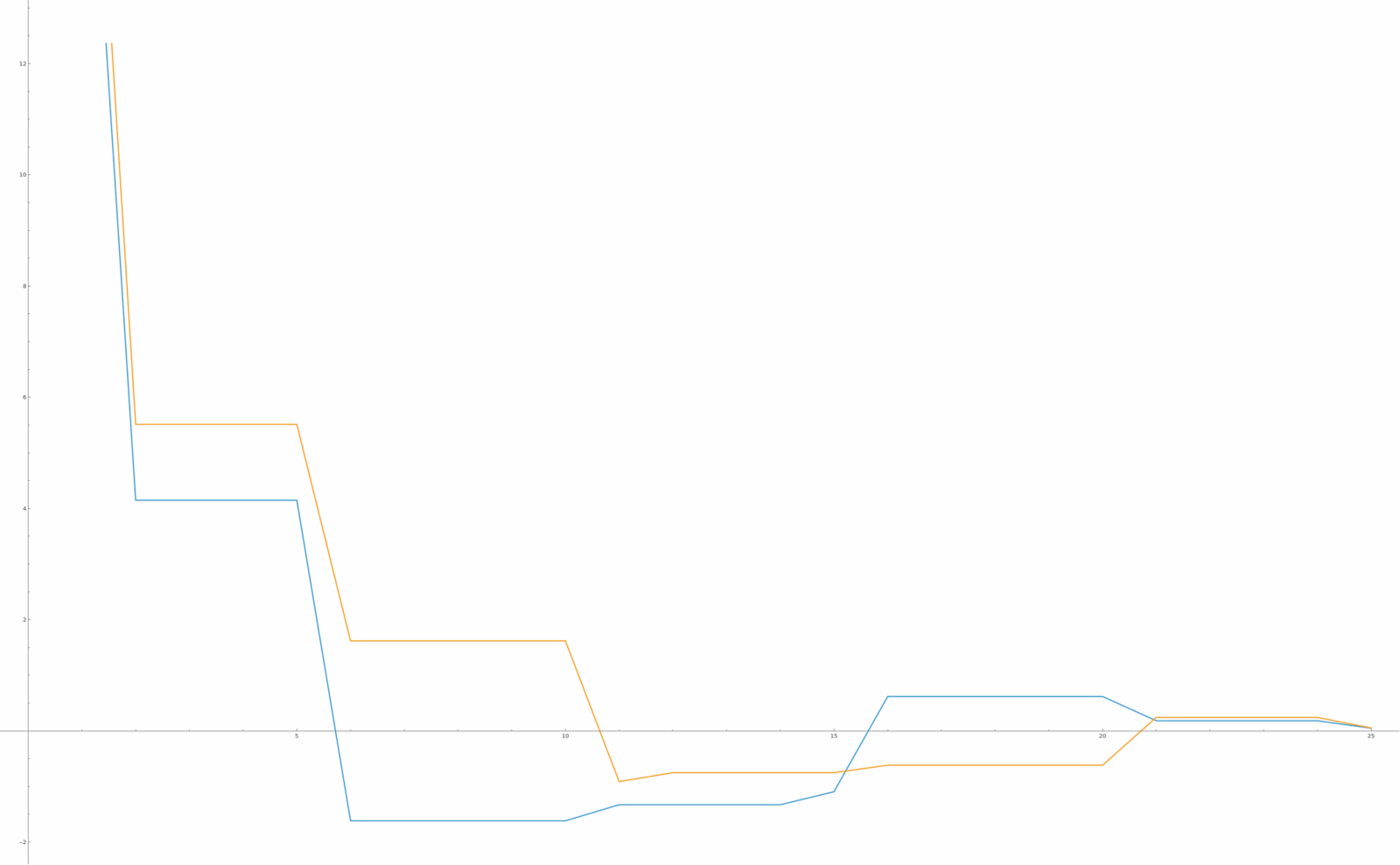
And here are the matrices L, and g the inverse of L and then the spectra