
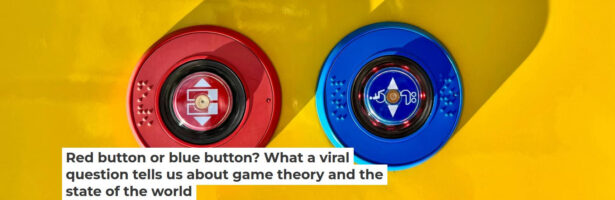

This spring, the red-blue button dilemma went viral. In that scenario, every human on earth has to make a decision to push a red or blue button. If more than 50 percent of the populationpush blue, all humanity continues to live. Otherwise, only the ones who have pushed red survive. It went viral as it is considered some sort of litmus test whether you are “good” or “bad”. A “good” person of course would push the blue button, while only an egoistic person would push red. Both strategies are Nash equilibria, the benefit of the blue button pusher is even to “feel good” and have “virtue signaled” that. Pushing the red button is safe, as you can not die. Any deviation from that strategy has a huge risk of damage, your own life. Pushing the blue button also has some benefit. It makes you feel good, it makes you a decent person. you can brag about it on social networks. The analogies with climate change are obvious. Unfortunately, I did not hear about the Red-blue dilemma before our spring course. I had included the classical Newcomb’s paradox in the first homework of the course. A few weeks later, I would probably have chosen the red-blue paradox. In the Newcomb case, the split through the class was essentially 1:1, which is reported to be the case also when sampling with larger groups. In the red-blue button case, the verdict is not yet out. The social media polls which are available are misleading and the reason is virtue signaling of course. The top picture by the way is from this article in the Conversation”. There is also a link in that article to the picture seen to the right about the AI “poll”.

Now, after months, I personally see clearly that the verdict is clear: most people would push the red button. It reinforces the message that pushing the blue button is simply suicide. There are polls like this which indicate that 57 percent would push the blue button. One must note however that on the social networks like facebook, people do not say they would do. They signal what looks good. It reflects bad on your character to say that you would push red. But if the vote was completely anonymous and the rationale “everybody will chose red to be safe so that only idiots push blue” will certainly prevail. I have looked at many online comments and it appears comments like “I would not want to be stuck in a world where only red pushers were left alive” do signal to your peers that you are a “good person”. But talk is cheap. What would the person do, if it is real? Make it more extreme and assume you are pointed a revolver at your head and you have a red and blue button in front of you. You know that if you push red, you will live but that then everybody who pushed blue will die. And if you push blue and less than half of the population pushes blue, you die. What would you do? We all know the answer. It is cheap to say: of course, I would push blue because I can safe millions if not billions from dying. But of course, you also know that by doing so you might die, maybe almost certainly if one looks at the polls. It is not Russian roulette with a 1/6 chance, there is even on social network polls a 2/6 chance that you die. And if one looks at comments online the chance is probably 5/6 that you die. Interesting also the graphs which have appeared about experiments done with AI. I attached above one of the pictures found on X. The picture to the left I have AI generated (GPT) . I asked it to illustrate the dilemma with a clear picture, explaining the dilemma.
The mathematics of this “game” is a variant of the prisoner dilemma if played by two players. It obviously has two Nash equilibria, one where both push red and one where both push blue. The red one has “safer” as you survive in any case, while the other is risky but giving the benefit of “having done good”. If you push the blue button, you at least die as a decent person (unfortunately you will not be able to brag about it if things go south and your peers (the world) abandon’s you). One can rephrase or morph the dilemma in many different ways. In the prisoner setting, one could replace “die” with “get executed”, while “live” becomes “get released”. It is already interesting in a 3 player set-up: if 2 or more push blue, all get free, all the ones who push red get freed. The assumption of course the prisoners can not communicate. There is no question that most would push the red button and get freed. The alternative is to take a bullet which actually will save nobody because everybody has chosen red.
Nash equilibria also are terrible in the case of “should I be using AI”? Yes or no? It is a brutal equilibrium which might be the end of us. Those who do not use it will lose as they get fired or not even get hired (I heared already last fall of students who have difficulty getting a job because they are not buying big into the AI hype. It is not so much the use. The use of AI is trivial. It is the question whether you go all in and replace yourself or not). On the other hand, the tasks which are done by AI now, are the ones which are getting automated. It already happens in literature, in music, in science. Workers at facebook are monitored and filmed during work so that they can be automated faster. It is insane. But it is also possible that if you delegate work to a machine, you lose the grip on the workflow. Having somebody else do the thinking for you could make you dependent. I myself do not know how this is going. But humanity might just have to go through this experiment. The Nash equilibrium can not be broken by policies or rules. We will go that way and we will have to see what happens. It does not look good. It is a very bad Nash equilibrium.
By the way, when I was in high school and college, there were no AI or game theory courses. I myself learned about game theory from discussions in Martin Gardners books and columns. We had the Scientific American (Spektrum der Wissenschaft in German) and I read some of his columns and later almost all from Hofstadter, in his “metamagical themas” The column about “Tit for Tat” was especially fascinating. Hostadter discussed there the success of the Tit for Tat strategy of Rapoport. There are a few things during high school which immediately clicked for me and this was one of them. It is a paradigm how one can overthink things. Sometimes, simple solutions, simple strategies are the best. (Occam’s razor has made this to a meme). Unix is an other great example (I only learned about Unix in college as Unix computers were un-affordable at the time). Apropos exposure to game theory: the focus at that time was a bit different: complexity theory was in vogue (NP completeness especially as it was then already more than 10 years after the Karp list of NP complete problems. I actually had to talk in a Specker seminar about the graph isomorphism problem. Which is still interesting these days, as one does not know whether it is NP complete or not. I had been given that topic essentially random. I don’t remember having had a choice. But I’m glad to have gotten this as we never also had a formal Graph theory course. Specker had also been my linalg teacher for 2 semesters (2 semester calculus and 2 semesters lin-alg were mandatory for the first year at ETH and there was no choice about level) but Specker had some homework problems also on graphs , as I remember, like counting the number of spanning trees.
Simplicity is very powerful. This is important everywhere. Especially in democracies: the structure of voting for example should be simple and clear. Simplicity produces trust. Tit for Tat was is also a prototype of “honesty”. There is no hidden agenda. The structure is clear. You are good with anybody who is good to you. If you are mislead, hit back hard, but only once. then return to good. Axelrood wrote already in 1985 a book on the evolution of cooperation in which Tit For Tat was discussed prominently. (The book had a foreword by Hofstadter).
Update Mai 22, 2026: one of the most funny things found on the internet about this topic is a video of a streamer called Asmond Gold who was probing live some AI with the question what button different folks would push. The stream is here. Interestingly, he himself argued for the blue button (stating that this is a core of western civilization value). Indeed, the AI probed put Aristotle, Socrates, Marcus Aurelius into the blue button team and put Nietsche, Hitler in the red button team. The most funny part was when Asmond Gold asked Gemini what Asmond gold would push and the AI answered “Asmond gold would press the red button without a moment’s hesitation and he’d probably spend the next 20 minutes on stream explaining why anybody who pressed blue is “literally insane”“. It is funny how even the AI stereotyped and so strongly, without any hesitation. Still, I agree with the live audience who watched the stream. Most thought, that the gamer actually would push the red button. Even the AI argued that the “gamer” would look at the situation like a “game mechanics” and see the red button as the “strictly dominant strategy”. From a game theoretical perspective this is true. There are two Nash equilibria but the dominant one is the ‘red button’ because you can lose so much more when pushing the blue button. If one has followed the internet in the last couple of weeks, it is quite evident that the majority of the population would push the red button. (It depends of course, which side of the isle (or which bubble) one follows, the liberal side of course favors the blue button while the conservative side favors the red. Still, it is easy to virtue signal. It does not cost anything to put a shield into your back yard signaling love, compassion and tolerance, but when it concerns your own neighborhood, most vote accordingly to their own interest. Everybody does. It has not happened, but I would predict that if the town would decide to put a refugee or homeless shelter here, the majority of the town would reject it and give rational reasons for it. They wanted even to put once a Canabis shop a few hundred meters from where I live and there was heavy opposition and the Canabis shop did not come (I myself of course also opposed it, as statistically, it is known that near such shops there is more risk of crime. And here in Arlington, many kids still walk to school every day. There are parts of the country this is no more possible.). This happens universally, everywhere in the world. Folks prioritize their own life and one can not blame them for it. Most of course would never admit it, but this is what happens. That is what everybody does. Many so called educated folks (like me) live in heavily gentrified areas of the world and have no idea what it means to live in a high crime part of a city. And the resistance to have a more risky neighborhood happening is obviously large. There is a reason for example why towns like Arlington or Lexington have resisted the green line (subway) to extend further. We live in towns, where one can leave the bike outside the house unlocked. I have never myself experienced any violence or crime or theft in this town, not even heard of a robbery or assault in 26 years. It is very safe. Just to say, it is easy to signal virtue if one lives in such a stable part of the world. It is essentially free to signal it because the risk that there is change is small. Putting up such signals makes you a “good person”. It is much harder to live the virtue that is bragged about: if life is tough and if the streets near your house are full of addicts who sell drugs, the choice is no more so obvious (there are still some who like that as brings the house prizes down … ). It is heart breaking to see run-down in many towns, including parts of Boston. Pushing the blue button means almost certain suicide if as the game demands would mean that the entire world votes. Of course, if one would do the poll in Arlington MA, one could safely push the blue button. Asmond Gold is a genius in knowing how to sometimes go against the herd opinion, sometimes controversial. He argued in that video for example that all women would push “blue” so that this would already tilt the odds to the safe side. He might be right, but would he really bet on it, if it really counts? Well, he is for a reason one of the most successful streamer at the moment. He knows how to push the right buttons …

