[Update: May 28: I have an expository paper on this uploaded now. Ha a few days for focused writing.]
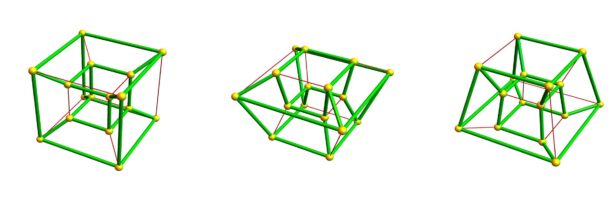
I encountered the Moebius Kantor Graph when trying to get better geodesic sheets in discrete 3-manifolds. For , the smallest 3-sphere, all dual spheres of edges are graphs and the geodesic sheet becomes the octahedron in the form of its dual, the cube. The dual of is the iconic tesseract. When looking at frame bundles, the Moebius-Kantor Graph emerges, a 2:1 cover of the cube. This was first noticed by HSM Coxeter in 1950. The following 2 pictures are pasted from Coxeter’s article. They show two ways to draw this graph and also rather quickly show that it is a subgraph of the tesseract. To get back to the topic covered in the last couple of weeks, one can see this graph as the game graph of 2 games as it is the Cayley graph of groups and , both groups of order 16 but not isomorphic. We computed a lot of stuff using GAP. Below is the GAP code for the first game. The second game is the Pauli group P1, where the Pauli matrices generate the game. The two groups are not isomorphic. But with suitable generators, the two groups have isomorphic Cayley graphs, the Moebius Kantor graph. The god number is 4 as you can see immediately from the picture. The game is not difficult if you have the Cayley graph as a map. The Rubik cube can be seen as a “big brother” of the Pauli group because it has a similar structure. In the Pauli group the base is , while in the Rubik cube, the base is . In the Pauli group the fiber is the Abelian group , in the Rubik cube the fiber is the Abelian group . Both are non-trivial fiber bundles with an Abelian structure group! The fiber bundle picture is not used so much in the group theory literature of course, but as a mathematical physicist myself, I like to think about the Rubik cube and P1 as fiber bundles. I wrote about graphs groups and geometry in this article from 2022 (it had been developed around 2008 (there is a little bit of story at the end of that article about the genesis (*) The semi direct group structure of the Rubik cube was by the way pointed out already in 1979 by David Singmaster, who was the first mathematician who seriously thought about the Rubik cube shortly after it appeared. As I pointed out in the talk, the topic covered here illustrates well the “unreasonable effectiveness of mathematics in natural sciences” (the article of Wigner from 1960 which is still nice today). We have here a topic that bridges the 1-Bit group of Pauli with the Tesseract, with the Rubik cube, with sculptures of the Tucker group. And I myself encountered the Moebius Kantor graph as a 2-dimensional geodesic sheet in the smallest 3-manifold there is where it can be seen as a Hopf fibration. We link several pop culture topics like “quantum computing”, the “hypercube” (tesseract) , the “3-sphere SU(2)”, (unit quaternions, weak force in physics), nontrivial fiber bundles, the “Hopf fibration” (tori in 3-spheres) and “trajectories in general relativity” (geodesics) and the “Rubik cube” (household puzzle). And all this just coming together in a small graph with 16 vertices!
(*) during the summer of 2021, I almost died with a pulmonary embolism which had been triggered by an unexplained spike of clots in my blood. I was picked up at home by an Ambulance and driven to the emergency room in MtAuburn, they gave me some extreme blood thinner shot and the issue was resolved overnight. I took blood thinners for a while, until the blood clot was back to normal early in 2022. As a scientist myself I of course welcomed the vaccination efforts from 2021 to get out of the deadly pandemic but it became clear later that the technology had not been tested properly and that lots of side effects (collateral damage) had to be accepted. This is now well documented. But if you are affected yourself, it makes you think. Especially, as this was the time when lots of science and media lost credibility. It is never good to deceive, even if it is under good intention. We all know that the trust of the public in authority is still very low. And this is well deserved. Anyway, I was in the hospital during a weekend. The clot dissolved quickly but I had to stay Saturday and Sunday for observation. I used the time in the hospital to grade the midterm exams for my summer school class (online then of course) and started to look back at the “Graphs-Groups-Geometry” paper because I thought that this is one of the ideas I had which I do not want to be lost if I would have to cross the Hades. The story had a happy ending. I defied doctors orders not to run for a while and made a 10 K the day after and a half marathon 1 week later. I did not even miss a single class that summer and the students got their papers back on Tuesday. Only OH on Monday had to be canceled. The best was however that this shock made me think to look at the “natural group” topic, something which might otherwise still rot in my hard drive somewhere, like other projects.
Coxeter’s observation that the graph is part of the tesseract is illustrated in the following picture (the idea is from the last century, the picture is mine). The picture to the right is from the website mathematik.com (which I have neglected since 20 years, which I always have kept just as a possible dump for all my math content in case I would do something different. As Coxeter prescribed, I deleted just 8 edges from the tesseract to get the Moebius-Kantor graph. The graph is the Cayley graph of both and , where X,Y,Z are Pauli matrices, the basis for the Lie algebra su(2) of SU(2). The Automorphism group of the Moebius-Kantor graph is the Tucker group (named after Tom Tucker) who showed that it is the unique group of genus 2.
Here is a picture of the Tucker sculpture (the last picture is an attempt of Liz Slavkovsky and me to make it 3d printable in 2013, we were lazy with the details, well it was one of 100 objects we looked at….) . The left pictures were from some slides, which Tom Tucker once shared with me around 2012/2013.