
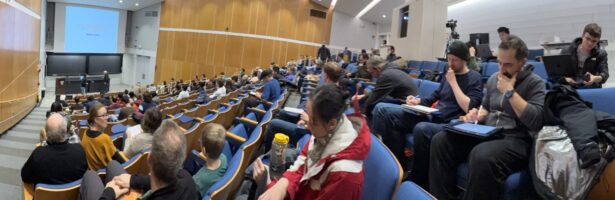
For slides and first remarks about the P-NP problem, see this page. I mentioned there my own personal predictions about the Millenium problems. See also this talk from 8 months ago about the perfect number problem in which also all Hilbert, Millenium and Landau problems are mentioned. So, here is what I think will happen: the “people problems” (Hodge, BSD,RH, N-S) will tumble this century; the Riemann-Hypothesis will turn out to be false, the P-PN problem will turn out to be unprovable (which was mentioned by Sudan by the way). (It also would imply P is not equal NP, but we will not be able to formally prove it) and the mass gap problem is an ill-defined problem. As mentioned before, I believe (like Turing did) that the Riemann hypothesis is false. Why? Simply because there is no reason why it is true. The probability to have a “root event off the critical line” might be very improbable, like winning a million dollars in the Petersburg casino, but it only needs a positive probability to be false, not an “engineering human experience type of probability” . An example of a mathematically positive but practical zero probability that I do not die in the next hour by suffucation because all gas molecules by chance have left my surrounding for a half an hour. It is an improbable event, but not impossible. (R.E. Crandall metioned in his SciAmerican article of 1997 already examples like 10^(-10^(33)) being the chance that a can of beer tips by quantum fluctuation, 10^(-10^(42)) , the probability that a mouse survives on sun for a week. Or 10^(-10^{51)), the chance to find yourself on mars by quantum fluctuations.)
- Poincare conjecture has famously already been solved. Was a great problem and a great solution. (Freedman’s talk is mentioned here)
- Navier-Stokes. Will be solved by giving unstable solutions. There is no global existence theorem. It appears that mathematicians are close to this one.
- Hodge conjecture. Will need more refined definitions. With correct definitions it will be true with different definitions false. (Deligne’s talk was a disappointment)
- Riemann Hypothesis will be shown to be false. This is what Turing already felt. See also this talk of mine on perfect numbers. For me, RH always had been convincing because of the randomness of the Moebius function, but stories like the Mertens conjecture or indications that Moebius is not random enough could be telling.
- Birch and Swinnerton-Dyer will be shown affirmatively with hard analysis refining techniques already known. Why: quite many problems in that real, while hard, had been proven using new and clever techniques.
- P-NP problem will be unprovable. In that case it will be true .but we will not be able to prove this. (See some slides of Sudan’s talk). Why? Because once you can jump the barrier NP to P, you could possible iterate that and possibly get to a point to solve the Halte problem. This is a wild guess but the fundamental nature of the problem makes it the most likely to be undecidable within ZFC.
- Mass gap problem will never be solved (or then declared to be solved by politics) simply because it is an ill posed problem. (see Chatterjiee’s talk) The problem might produce some fruitful pursuits in probability theory but the mathematics explaining quark confinement might be completely different.
Predictions are cheap. There are 2^6 *6! =46080 different predictions for outcomes in the Millenium Lotto. I could give any of the AI tools the task to formulate all of them out and write blog entries about them using different names. One of them will be true! Guessing right is often considered a skill while it is often just a matter of luck. Take a 1000 experts and let each guess. Then pick the one that is right.Genius? No! it was just the lucky one. However, I mentioned above also some reasons, which is a bit less silly than just guessing.

Climbing a mountain with a helicopter! Wow, I’m so good!
P.S. If any of these problems could well also be proven AI assisted, I wow not to look at it. I’m in principle not interested in math done by robots. This is not lazyness or lack of interest (I have worked on AI bots more than 20 years ago here when everybody was laughing at me in the department. No, it it is a stubborn reflex to remain a human and independent thinker. I refuse to outsource my thinking. If a theorem will be proven by an AI first, I will just not consider it a good problem any more. Having machines take over everything we are doing is nihilistic. We might not be able to avoid it, it is most likely that we will die not by AI enslaving us but AI having making us stupid idiots. Learning how to work with AI is not an achievement. Every idiot can do that. You do not even have to be understand the problem. Just take the problem at hand and feed it into the machine (link the PDF of a task for example to the prompt). You don’t even need to be able to read; only have the money to pay the subscription!
One often hears the argument that one “should learn how to enter good prompts“. Good lord, this is only temporary. The task to find good prompts was already been solved on November 2022 when Chat GPT came out. The proof is that millions of humans figured it out almost instantaneously within a few days. I definitely was impressed myself “instantanously” (the day after) when it came out in the fall of 2022. (now 3 billions = half the population on earth) know how to use it. I have seen kids doing their middle school homework using AI in coffee shops. The task to to build prompts or delegating problems to the machine is a task which the AI can figure out fastest out itself: give a prompt, check the quality of the result, modify the prompt, give more details etc. repeating and quality checking is something also a machine can do. We already have agents working independently and chaining their tools. If I watch mathematicians prove something with AI, it is like seeing an alpinist bragging to climb a mountain with the helicopter. I myself have no respect, only contempt . I feel pity. We are not doing mathematics to HAVE, we ARE. I myself do not need to watch this. I constantly dislike also anything on the web which appears to be AI generated. It does not matter anyway because soon, the machines will prove results which we no more comprehend. And they will produce millions of “fans” who like their stuff. (already happening as one estimates, that half the web consists of bots).
(The illustration to the right was done in less than1 minute using a midjourney bot, there was no skill involved! I just entered that I want to see an alpinist climbing a mountain with the help of a helicopter. Does this need skill? No! But I can still take credit and pride for the idea that “doing mathematics with the help of a bot is like climbing a mountain with the help of a helicopter!”. This is an original thought I believe. I feel happy about it because I created it myself. If the machine would have created that it would be worth nothing. Value systems are still done by humans, not bots. This might change, but then it is the end of art and science as we know it. Why does the value system for bots no more work? Because once you have one bot doing something, you can build a million bots who can and also like each others stuff (already happening on social media), even so it is worthless in a traditional sense. Maybe this is the way humanity ends. We all thought the end of humanity would be some sort of apocalypse like a meteroite or nuclear war or AI take over. No, the end of humanity is nihilism: we will no more see any reason to do, learn, create anything. Once we see that anything I can do, a million bots can do a trillion times better! We can not even laugh about it any more because also humor will soon be taken over by machines. (also already happening in most comedy shows where the laughter is artificially generated. Nothing wrong with that, it just should be declared as such).
The P-NP problem is special among the problems also because it taps into fundamental questions of computatibility and logic. We have to make some assumptions like the Church thesis in order to operate. We also have to make assumptions about the consistency of our axiom systems. Both can never be proven. The Church thesis would be wrong of course, if we had access to an oracle like a god to answer our computing questions: “Dear god, give me a Hamiltonian path for the following graph”. If I have a good connection to God, this should not be problem as god knows evertything (at least by theory). As for the inconsistency it is a general principle that strong enough systems can not verify within themselves whether they are consistent. It is perfectly possible (as Sudan has pointed out) that the P-NP problem does not actually have a proof.
We might anyway have to retrench to the finite at some point.
