
During our high school class reunion I took the following picture (bottom of the page). It shows the abbey of St Katharinental which goes back to the year 1242. The members of that convent collected and illustrated especially graduals, some of which go back even 1000 years from today. Monasteries played a similar role than what modern data-centers do. It dedicated time writing, illustrating, copying and collecting data. On the picture below one can see one of the best protected places, a SWIFT data center, where world banking data are processed. There are three such centers, in the world (one in Holland and one in the US). It is well protected, does not look impressive, given that most of the center is underground. Anyway, the picture is for me a picture how things have evolved. The way how information is copied and transferred has evolved, but the principles have been the same: we create data, store and preserve them for later use. The songs and prayers back then been by the Dominican nuns living in a network of convents, today banking data are funneled through data centers. The place would be a fantastic setting for a Dan Brown type thriller, as many of his stories collect different parts, from the spiritual to the technical, from religion to science connecting past and present. Our class reunion took place at a critical turning point of humanity. Most professions have not realized it yet. We mathematicians were the first who had a clear moment on September 8th. For other professions, like doctors, teachers, politicians or lawyers (they were all very well represented in our group of our high school class), the transformation is only seen gradually. If our reunion would have taken place one month earlier, I myself would not have been worried at all, about how far we have already lost. But having spent a bit of time for a project in group theory in the presence of high grade artificial intelligence has change my mind. This paper of Alex Sutherland on natural groups has been written within days after I have mentioned the problem on youtube. I must say, that I was flaberghasted about the quality and debth of that paper. Even so, that paper was authored with some help of AI, I must say, this is shocking because it was done in such a short time. It is not just a computation or search for a counter example. It uses genuinely original ideas combining different parts of mathematics, like elements of descriptive set theory. I had at that time been writing a follow up paper on natural groups. When seeing that result of Sutherland, I immediately decided to wrap this paper up (even so only started 2 weeks ago). The development goes too fast. I wrote there on September 7th, that “the mathematical world will look different next week” but not knowing anything about the September 8th event, when the solution of one of the major problems in mathematics has been announced, authored by 10’000 agents working with AI models that go beyond the level of what we mortals are allowed to see and use.
The reason why the general public does not know “for whom the bell tolls” of course is, that the AI which are fed through search engines or given for free is relatively stupid. Sometimes really stupid. I found that the transition from GPT 5.6 luna to GPT 5.6 sol was a real game changer: suddenly you have the impression speaking to an expert, more even, to somebody who already knows exactly where you are going, to somebody who already knows the answers to new questions you are going to ask. And I have not even spoken to GPT 5.6 astra yet. As Yuval Harari once said, it is the first time in the history of humans that technology does not empower us more, but that it has made us weaker. And this process has only started. But we mathematicians know now who is boss because we have clear bench marks in the form of theorems. We have started to outsource thinking, there is no glory of discovery any more, as one does not know whether a result has been written by a person or by a rich kid that can shell our 400 dollars per week for a high grade intelligence. Not to speak of the technology company themselves who can throw millions of dollars and 10’000 agents at the same time to a problem. If things continue as they do now, then this task can in a few months be done by a cheap AI model for the commoners, while the AI overlords have already access to machines that are 1000 times stronger than any living fields medalist. The achievement of humans is buried. There is little hope to discover something that might be listed in any future math text. And this is brutal especially for mathematicians who work not so much for the prospect of gaining money (I earn less than an intern in a hedge fund company, even so I have learned math for 40 years averaging maybe 80 hours per week on mathematics), but because it is great to discover something nobody has seen and because it is exciting to explore things nobody has seen before. The generation which gathered at this class reunion could be the last of its kind. The world has changed in the last few decades more than what happend during the last 800 years since the members of the convent had lived there at the river Rhein. And Harari rightly has pointed out, every technological change, from melting iron, the printing press, to the steam engine, electricity, computers and the internet has empowered humans more. No more. We give away power now to an other species that has grown stronger than us.
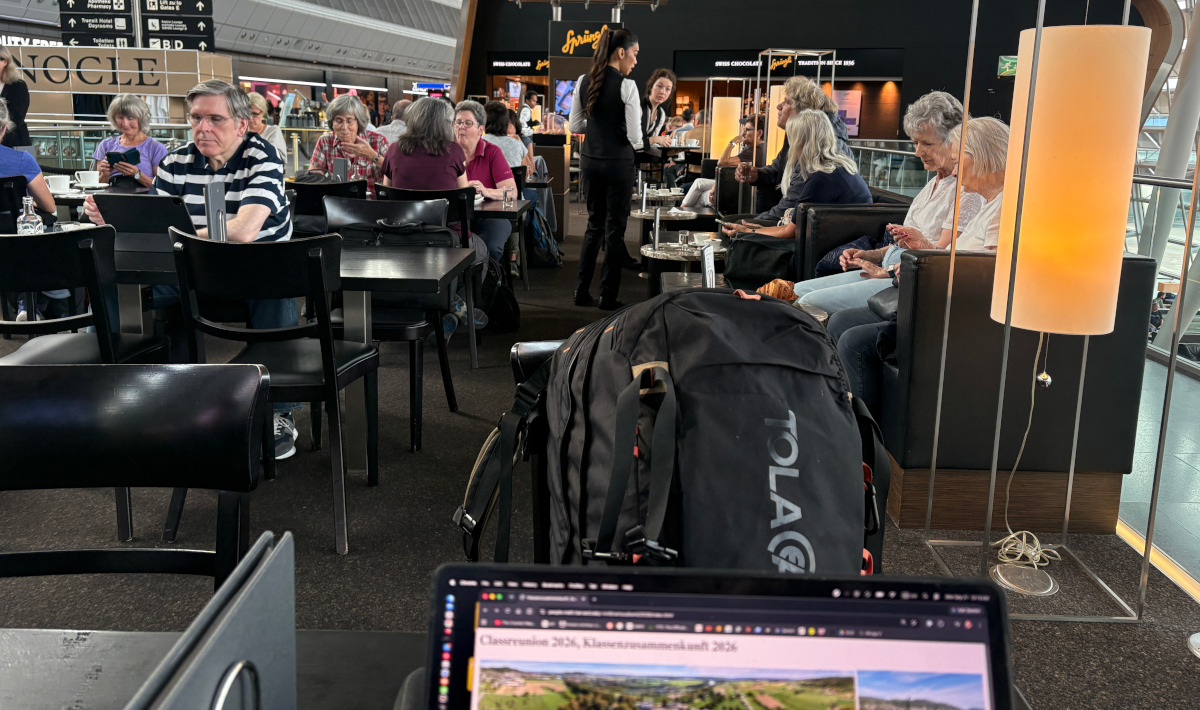


[Added September 22, back in Boston, the rest had mostly been written at the Spruengli coffeeshop in Zuerich airport] And this only within a few years. 22 years ago we wrote a working paper: “An artificial intelligence experiment in college math education” which mused about the Turing test in education, the question whether an AI student could get a university degree. Now, we have seen that AI can get a fields medal. At that time, it had really been fun to think about AI, because we were teaching everything by our own bare hands to the machine. When Chat GPT appeared in 2022, I was naive enough to believe that I as an individuum could catch up and get the information locally. But then, you realize how large these training data are. I still have a hard drive with 1 TB of such data dated January 20, 2023 (see screen shot from the left), when GPT was still a kid, with the brain of a toddler. There would have been 100 TB needed back then to store just raw data (not yet processed). And that was only a tiny part of core data which these AI companies have accumulated, not yet including any data gathered from the web all over the world. Who has the money to only to store the training data? Its not only buying the hard drive for one, you also need redundant backup. (As a side remark, the harddrives which I bought in 2022 are now more expensive than back then. And this is only the start, once the data are given one has to process it into a LLM. Not even a billionaire could afford that kind of money. And the current leading AI companies live all from borrowed money, living from the promise to once get it back (or bailed out by the government as they are too important and big to fail). Not to speak that all AI companies currently feed from data we humans have created in the last 1000 years. ]
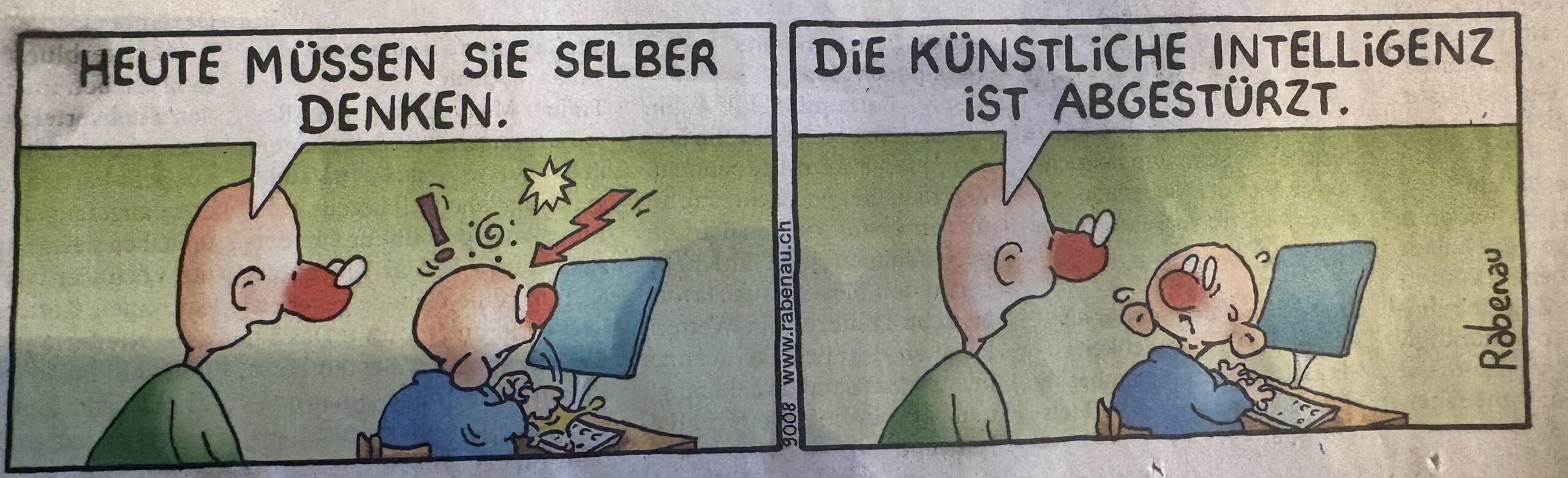
Before flying back to the US, I saw at home in the Schaffhauser Nachrichten (swiss newspaper) a cartoon: “Today you have to think on your own, artificial intelligence is down”. It is a very optimistic cartoon. Why would AI even need any human input any more? Already years ago, one has laughed at the promises of the CEO’s of AI companies assuring us that AI will produce new jobs like “prompt engineers”. It is no problem for a machine to generate the prompt by itself. This is the easiest part of the job. It does already: if you ask now for a keyword in google, a early high school grade level AI gives you a blurb and at the end suggests some follow up questions.
But maybe our destiny is going back to the roots, farm land, raising chicken, grow wine and food while there will be a few who live in convents writing songs about a time, before the machines started to rule the world.
At the moment, I do not see what to do (and nobody else seems to know except just watching what happens). Regulations will not work because we have different companies and different countries competing and because there will be also a huge military advantage for anybody who uses strong AI. Of course there are efforts for AI safety but that is not so much of immediate concern. The immediate concern is “demotivation” and “resignation”. As for math, asking or forcing companies to keep theorems secret they found will demotivate even more, to do research. It could also be dangerous for example, if the AI companies know how to factor integers fast but do not tell that to the public. I also do not believe that an AI advisory board as announced today by OpenAI will have an impact. It is a political attempt to calm the uproar in the community. I’m not sure whether that works. We mathematicians might be naive in general but not so much known for being stupid. Maybe it can achieve something in the US, but not globally, in the world. The word “severe misalignment of AI in mathematics” used by a group of mathematicians is an euphemism as it is a core attack onto creative professions, not just a “misalignment”. A few days ago, the SAIR open math model initiative was founded. We will see where that is going.
[Again added September 22] So what now? I myself am not that pessimistic. Predicting the future has always been difficult and things usually take turns nobody has foreseen. 13 years ago, Liz and I wrote an article “Illustrating mathematics using 3D printers” . A that time, the prospect had been that all education would go “massive online”. The MOOC’s war happened. We all know where that had been going. It allowed to spread education more, yes, but it fizzled out. Especially now, in a time where one can build bots taking such courses and pass with flying colors, it does not work for getting institutional credit. As for education and AI, once in a few years the data will be in (for example on how education works in this time or whether we are resilient enough to face the challenges), we will see whether things work out and whether it allows us to reach goals, whatever these goals are. And if it should get to the point that humans have to fight for their survival, we might see things, which no SciFi writer could imagine yet. And there are so many open questions nobody can tell the answer to: how do these AI companies get their money from, if nobody earns any more money because they have been replaced? From companies? But how do companies get money if nobody buys their product as they can not buy any more? We are in the buy-in phase of a drug that made us high and we know what comes after the “feel good” phase with drugs. A huge hangover! ]

