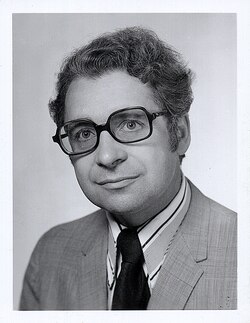
I just learned that Erwin Engeler died on July 28, 2026. It is rather strange to me as I had been thinking about Engeler a lot lately, when working on my “Elements in Finite Geometry” project.
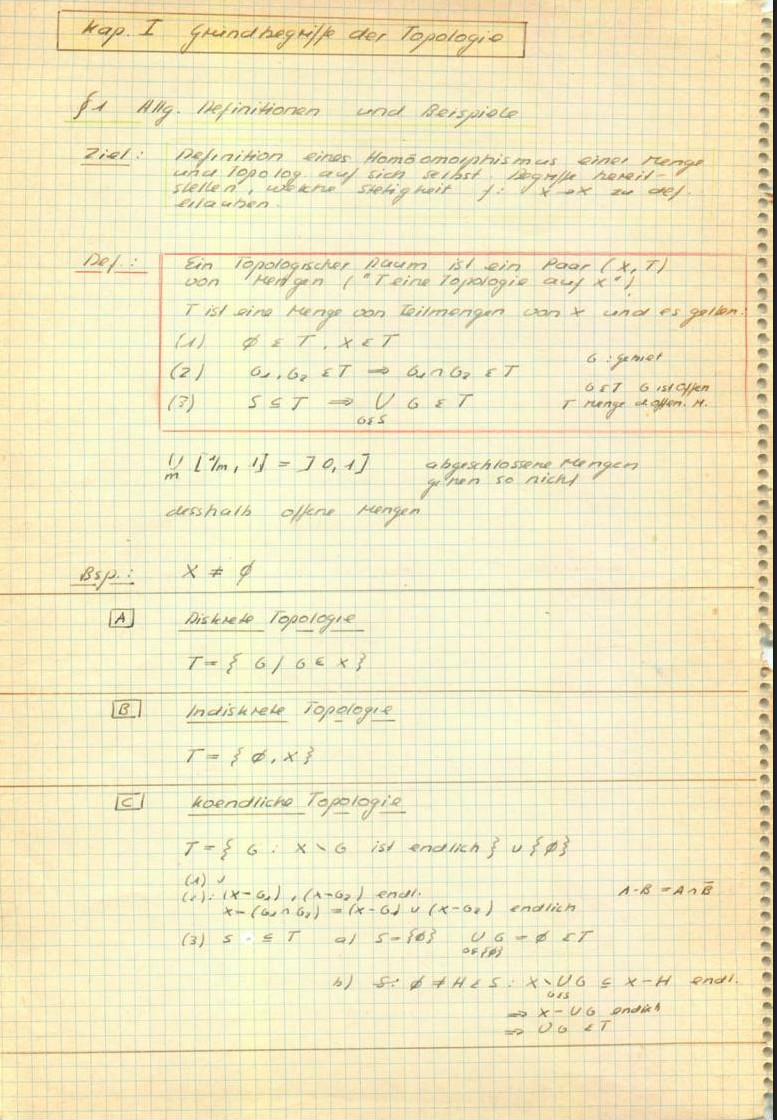


Engeler taught us topology in the 3rd semester. See my courses from college. As it was custom then, the course choice and level was not negotiable in the first two years. Everybody had to start with calculus, geometry numerics, linear algebra, physics, computer science, logic, number theory, physics, mechanics, topology, fourier and complex analysis, real analysis, abstract algebra, probability and statistics. It was hard, especially for those like me who had also to go to military ( I was driving M109 tanks) for more than 4 months during my second year. A clear set theoretical start in topology is extremely important. It is often learned “en passant” in many other curricula like at Harvard, or then “polluted” by geometry calculus or geometry. Nothing against geometry, linear algebra or calculus. We had 4 semesters of rather heavy calculus in the first two years and two courses on pure geometry as well as 2 semesters of linear algebra. But topology is an opportunity for a fresh clean start. As a high school student, I once met a blind student who studied math and he told me how excited he was about set theoretical topology. And it is exciting to see a subject developed without any wishi-washi hand waving, geometric intuition, (“it is so, because I told you so!” arguments one can see in virtually any calculus frame work). I have Engeler’s course here as a PDF (my own handwritten notes).
I have had a rather hard time in the first year of my studies at ETH, even so I worked very hard. One reason was that I had access to the first Apple computers and I would spend insane amount of hours programming them, not on homework but on my own projects rather than spending on course work. I changed strategy in the second year and it went then much better, once the time for programming was gone.
Engeler told me once about strict finitism. It was just a casual mentioning but it got me interested. Finitism is radical, but strict finitism is even more so. As a strict finitist, you don’t believe in numbers that are too large. I mentioned in a youtube video once the ultrafinitist Alexander Esenin-Volpin who was asked where to draw the boundary for a finitist, which he answered in a clever way. “I can understand 1, 2, 3, 4,5,…., continued to count with longer and longer pauses between them.” See this entry.
An important course for me was also the theoretical computer science courses , which Engeler taught us. (I took 2 such courses from him). One was mostly about Lisp but also computer algebra languages appeared as well as complexity issues and the usual stuff about Turing machines. I later would course assist for this course. We would give students some insane problems like designing an algorithm in Cayley that would find a solution algorithm for the Rubik cube. This was based on the Schreier-Sims algorithm in computational group theory. I enjoyed later as a graduate student already a course by Baumslag in combinatorial group theory and tried myself in solving an open problem which Baumslag gave us: show that the Gupta-Sidki group is finitely presented. I failed to prove it (otherwise, I might probably have morphed to algebra) but these efforts became useful when thinking about groups in the “natural group” project.
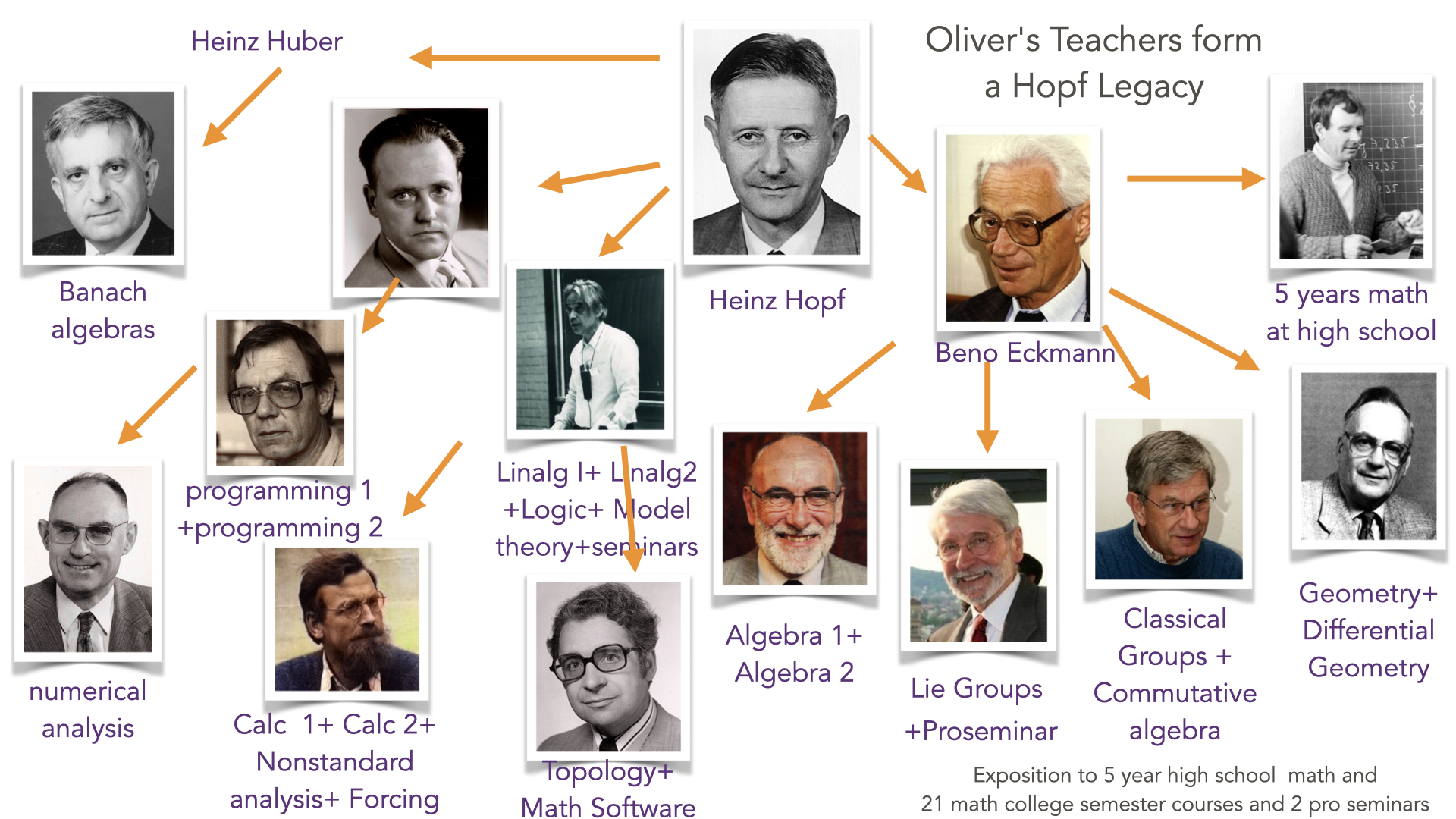
Erwin Engler was a student of Ernst Specker and so also a relative of Heinz Hopf. The Hopf family at ETH was huge (a slide with teachers of mine who were Hopf decendents). I knew also many of Engeler’s students, some of them have been my course assistants, some were course assistant colleagues, some I knew from the cryptology group (I would change from Artillery to Cryptology and would then have weakly go for 3 weeks to serve each year, which was much fun actually and also brought in some cash as logding and food was free, some payments were done for every soldier and additionally, the course assistant sallary continued to be payed. I became a rich man and could pay for a NEXT work station for 6000 dollars).
Engeler was an amazing teacher. Extremely clear as one can see from my notes in Topology. He also wrote a few nice books. My favorite is “Metamathematik der Elementarmathematik” which also goes into philosophical questions. We also had to read (as a side reading for his course on computer science, some “Berechnungstheorie” (theory of computation). The notes where then only mimeographed, but the “Leitfaden” appeared later in book form. It discusses complexity theory or regular languages.
Finally, I should mention that Engeler grew up in Schaffhausen and so probably went to the same high school which I attended. He must have been at the Schaffhausen highschool at a similar time like my father and my uncle. It is unlikely that they knew but not impossible.During my high school time, I hardly knew all the students in the parallel class (same year). Here is a picture showing my uncle (very left) and my father (second from the right), during their rowing time while at High school Schaffhausen. My uncle was 2 years younger than Engeler, my father 3 years younger. [Since Engeler hails originally from Wagenhausen a village close tor Stein am Rhein, it could also have been that he attended high school in Winterthur. Otto Bretscher, who is from Andelfingen was attending high school in Winterthur.]
Here are some snippets from his 1996 Abschiedsvorlesung at the ETH (at ETHZ professors all have to retire with 65 years). Klaus Hepp introduced him. (I attended a quantum mechanics course with Hepp).