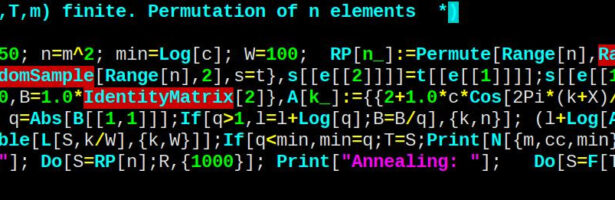
I still try to collect a bit of thoughts about the standard map problem. We would really like to show that for any measure preserving homeomorphism T of the torus and the transfer cocycle for the operator with , we have a lower bound for the Lyapunov exponent hopefully without a constant C. One can try to make numerical experiments for arbitrary permutations T of the squares of size . The measurements are pretty robust. One way to explore this, is not to worry about whether the permutation approximates a homeomorphism but just look at all permutations and use simulated annealing to make the Lyapunov exponent as small as possible. When using general permutations, the lowest possible value one can achieve appears to be lower than just but some constant might work universally. This works as follows: start first by using random permutations to get a good starting point, then use the gradient decent using transpositions to walk around in the permutation group in order to get to a value as small as possible. This entire simulated annealing problem can be done in 5 lines of Mathematica code. I used a lot of time with this finite problem during 1998 and 1999 during my time in Austin, Texas. I had my sun work station and Next computer do the computations. I had also been interested in the potential theoretical aspects. You find this all in my report of 1999 a version of which had been a claim once. I still think that a potential theoretic approach could work some day. There had been progress especially by Bourgain using the Herman method.
Here are some thoughts: use the Lauechli paradox by making the problem seemingly harder (take a general finite permutation of the little squares rather than homeomorphisms, one can use a larger space to explore and move around faster. One natural way is to make use of the fact that any permutation of n elements can be written as a product of mostly 2n pancake permutations. The argument is then that when flipping one of the pancakes to one has the same problem as the transpose of the product in the former is the product of the transposed matrices in a different order. The estimate for or of course should be the same. The difficulty then boils down to estimate how much the average Lyapunov exponent can change if we do such a pancake flip. In a deterministic situation, we can imagine examples, where the stable direction of the lower pancake pile just matches up with the unstable direction of the upper pancake pile but that is very unlikely. If we take a product of k matrices, then for almost all directions v, the growth of is exponential while the set of vectors for which we decrease the length is exponentially small. As we are able to vary the x value in each of the squares (pancakes) slightly in an interval of length , we should be able to avoid such coincidences and hope that a pancake flip does not change the minimal value much. We would only need something of the order to get in the limit the bound .
A concrete challenge is to find an m and a permutation T of the n squares partitioning the 2-torus such that for no choice maximal logarithm of the maxim eigenvalue of is smaller than $n log(c/2). The experiments I did search first for “bad permutations”, where if are all the same module $2\pi/m$ then the value is minimal. This brings us below . This is done with simulated annealing, marching around the permutation group. Then use simulated annealing again but adjusting the x values in each of the boxes. This is walking around in an dimensional cube. What happens then is that we can tune the eigenvalue to be larger than the conjectured threshold.
Just to reiterate: the claim that the lower Lyapunov exponent bound holds for any Lax permutation, not even approximating a measure preserving homeomorphism is very, very bold. Experts seem to doubt that. Tom Spencer once told me during 1999, when I was in Austin and thought of proving just that, that having such a lower bound for Lyapunov exponents bound independent of the map, is likely too strong. This could well be. Permutation groups are huge and we can experimentally only explore smaller parts of the space, similarly as in statistical mechanics we have only access to a small number of configurations. But having a large space makes simulated annealing effective. It sort of prevents bottle necks in the form of local minima which are surrounded by larger values. In any case, what makes the more general problem appealing is that we do not have to care about smoothness or real analyticity, we can use pancake flips for example to produce from one dynamical system an other one and intuition tells us that such flips do not change the Lyapunov exponent much and while the order of the permutation group is super exponentially large, the number of pancake flips is small, linear in n. Further more, the problem has become a finite problem for each n. Ridiculously impossible to exhaust by brute force search but nevertheless finite.